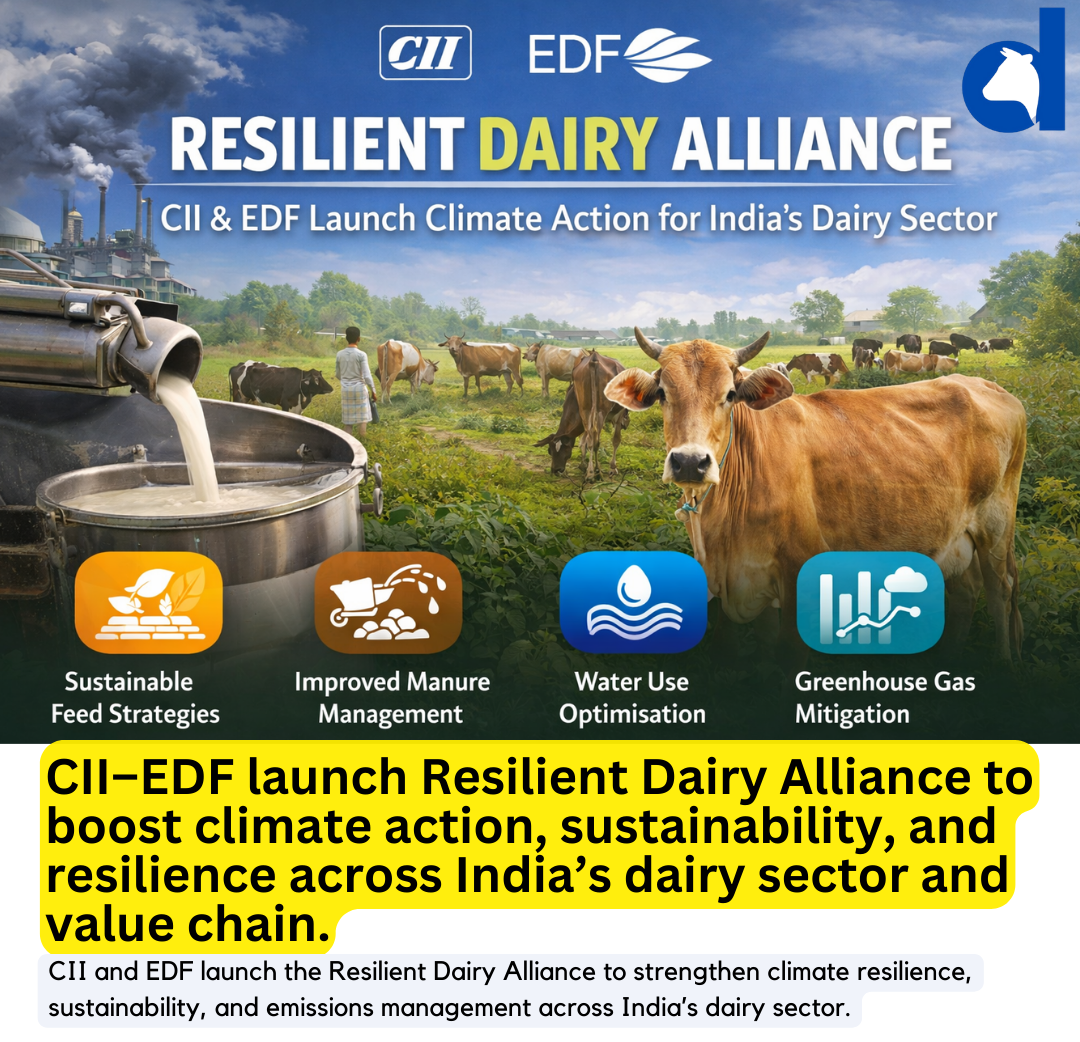
India’s dairy sector has taken a significant step towards climate adaptation with the launch of the Resilient Dairy Alliance, a joint initiative by the Confederation of Indian Industry (CII) and the Environmental Defence Fund (EDF). The partnership marks a first-of-its-kind effort to systematically embed climate resilience and sustainability across India’s dairy value chain.
As climate risks intensify—from heat stress and water scarcity to feed volatility the alliance seeks to bring together industry, civil society, and scientific expertise to address vulnerabilities that threaten both productivity and farmer livelihoods.
Climate Risk Meets Dairy Economics
Dairy occupies a central position in India’s rural economy, supporting millions of smallholder farmers and contributing to national nutrition security. However, rising temperatures, erratic rainfall, and resource constraints are increasing production risks, particularly for small and marginal producers. The Resilient Dairy Alliance acknowledges this reality by focusing on climate-smart dairy practices that reduce emissions while maintaining output. Its agenda reflects a growing recognition that sustainability is no longer peripheral, but integral to long-term sector stability.
Focus Areas Across the Value Chain
The alliance will work on developing actionable frameworks that enable the adoption of practical, scalable interventions, including:
- Sustainable and climate-resilient feed strategies
- Improved manure and waste management systems
- Water-use optimisation at farm and processing levels
- Data-driven tools for emissions measurement and risk assessment
By addressing both farm-level practices and downstream efficiencies, the initiative aims to reduce the sector’s greenhouse gas footprint without compromising farmer incomes.
Balancing Growth and Environmental Responsibility
Industry leaders involved in the alliance have highlighted the dairy sector’s dual mandate: meeting rising consumer demand for milk and dairy products while lowering environmental impact. This tension has become increasingly visible as India seeks to align agricultural growth with its broader climate commitments. The alliance positions climate adaptation not as a constraint, but as a pathway to improved productivity and resilience. Pilot projects and demonstration models are expected to play a critical role in proving that sustainability and profitability can coexist.
Bridging Public and Private Action
A key strength of the Resilient Dairy Alliance lies in its collaborative design. CII brings extensive industry reach and policy engagement, while EDF contributes technical expertise in climate science, emissions accounting, and environmental strategy. Together, the partners aim to accelerate the uptake of best practices tailored to India’s diverse dairy systems, ranging from smallholder-led cooperative models to large private processing clusters.
Data, Measurement, and Accountability
Experts have welcomed the emphasis on data and measurement systems that can quantify emissions and track progress over time. Reliable metrics are essential for identifying hotspots, evaluating interventions, and aligning the dairy sector with national and international climate targets. By strengthening monitoring frameworks, the alliance could help reduce uncertainty and support evidence-based policymaking in dairy sustainability.
Conclusion
The launch of the Resilient Dairy Alliance reflects a maturing approach to climate action in India’s dairy sector. Rather than treating sustainability as a standalone objective, the initiative integrates climate resilience into the core economic logic of dairy production. If translated effectively into on-ground action, the alliance could play a pivotal role in safeguarding farmer livelihoods, stabilising milk production, and future-proofing one of India’s most important agricultural sectors.