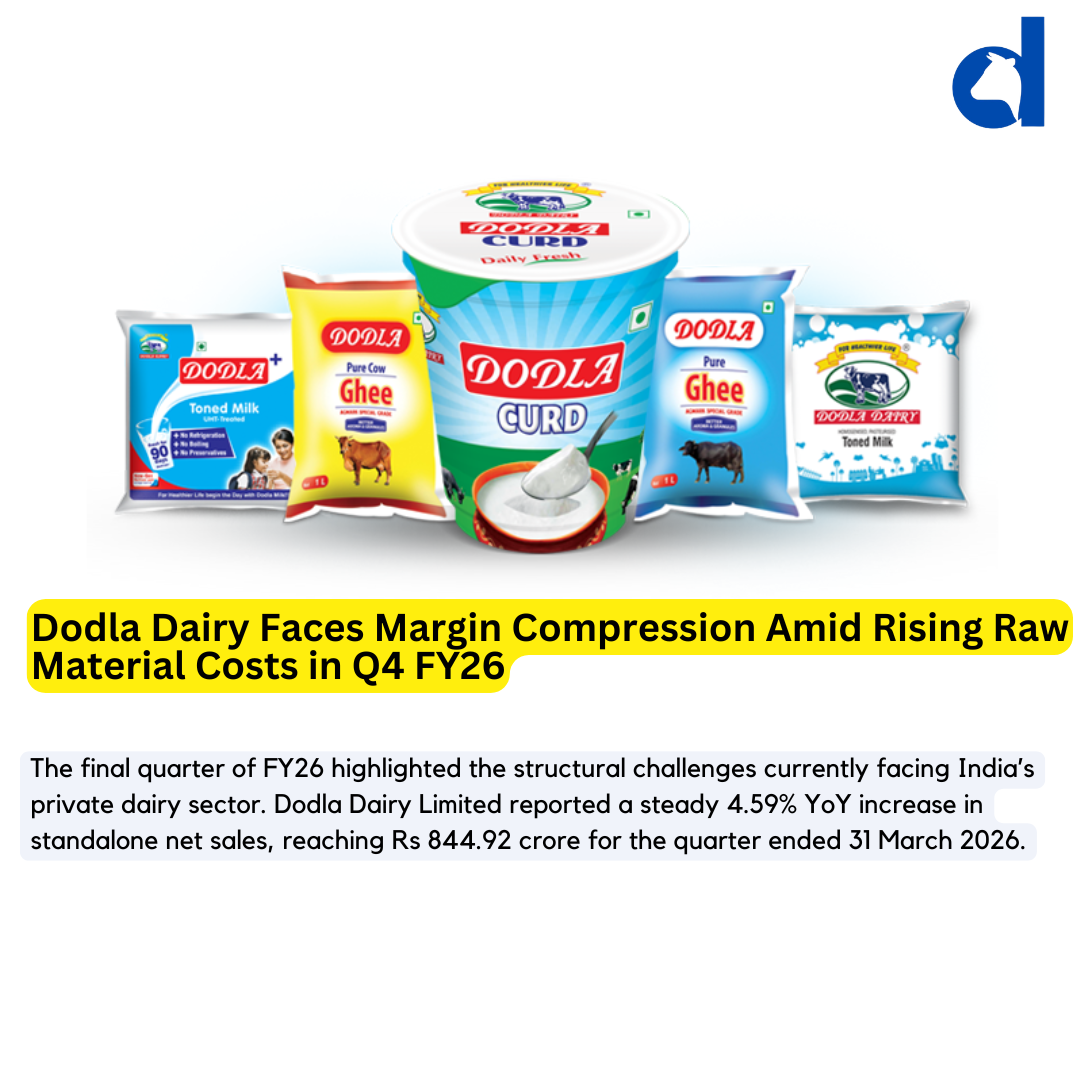
Dodla Dairy, one of India’s leading private dairy players, reported modest top-line growth for the final quarter of the financial year ended 31 March 2026, though profitability remained under pressure due to escalating input costs. The company’s standalone net sales for the fourth quarter rose by 4.59 per cent to Rs 844.92 crore, up from Rs 807.87 crore in the corresponding period of the previous fiscal year. However, intense procurement competition and inflationary pressures on raw milk costs heavily weighed on operational margins.
Key Financial Developments
The divergence between revenue growth and operational profitability highlights the current headwinds within the southern Indian dairy procurement ecosystem.
-
Operational Income: On a consolidated basis, total income from operations for the quarter ended 31 March 2026 reached Rs 1,094.64 crore, showcasing a broader market footprint through its domestic subsidiaries and international operations in East Africa.
-
EBITDA and Margin Contraction: Standalone EBITDA witnessed a sharp decline of 47.36 per cent, falling to Rs 48.17 crore from Rs 91.51 crore in March 2025. This contraction was primarily driven by a 17.56 per cent surge in the consumption of raw materials, which climbed to Rs 646.01 crore.
-
Net Profit and EPS: Standalone net profit for the quarter dipped slightly by 2.2 per cent to Rs 55.45 crore, down from Rs 56.70 crore. The decline was partially mitigated by deferred tax adjustments and a one-off exceptional gain of Rs 3.28 crore. Consequently, standalone basic Earnings Per Share (EPS) for the quarter softened to Rs 9.19 from Rs 9.40.
-
Dividend Declaration: Reflecting long-term balance sheet confidence, the Board of Directors recommended a final dividend of Rs 5 per equity share (50 per cent of the face value of Rs 10 each) for the financial year FY26, subject to shareholder approval.
Indian Market Relevance and Operational Realities
Dodla Dairy’s performance serves as a bellwether for the private dairy sector in South India, particularly across its core strongholds in Telangana, Andhra Pradesh, Tamil Nadu, and Karnataka. The quarter was characterized by unseasonably high raw milk procurement prices. Private processors faced aggressive sourcing competition from state-backed cooperatives and expanding national brands.
While liquid milk consumption maintained steady demand volume, the higher cost of procurement could not be fully passed on to retail consumers without risking market share. Additionally, increased employee costs, which rose to Rs 41.28 crore from Rs 36.10 crore year on year, added further structural pressure to the processor’s operating cost base.
Strategic Implications for the Dairy Industry
For institutional investors and dairy sector participants, Dodla’s results underscore the critical importance of value-added dairy products (VADP) in defending corporate margins. Commodities such as skimmed milk powder (SMP) and bulk butter faced global price volatility, making domestic value-added portfolios like curd, paneer, and ice cream the primary drivers of sustainable profitability.
Processors who rely heavily on liquid milk distribution are likely to see prolonged margin compression unless procurement prices cool during the upcoming flush season. Dodla’s consolidated full-year net profit after tax of Rs 267.00 crore, compared to Rs 259.93 crore in FY25, signals that diversified regional operations and a robust supply chain network offer a necessary buffer against localized procurement shocks.
Forward-Looking Insight
Looking ahead into the first half of FY27, the financial performance of corporate dairy processors will hinge on monsoon distribution and its subsequent impact on fodder availability and milk yields. If feed costs stabilize, operational margins should see a gradual recovery. Furthermore, Dodla’s strategic focus on deepening its direct procurement network from farmers will be vital to bypassing third-party inflation and securing a lower-cost, high-quality milk pool to sustain its processing capacities.