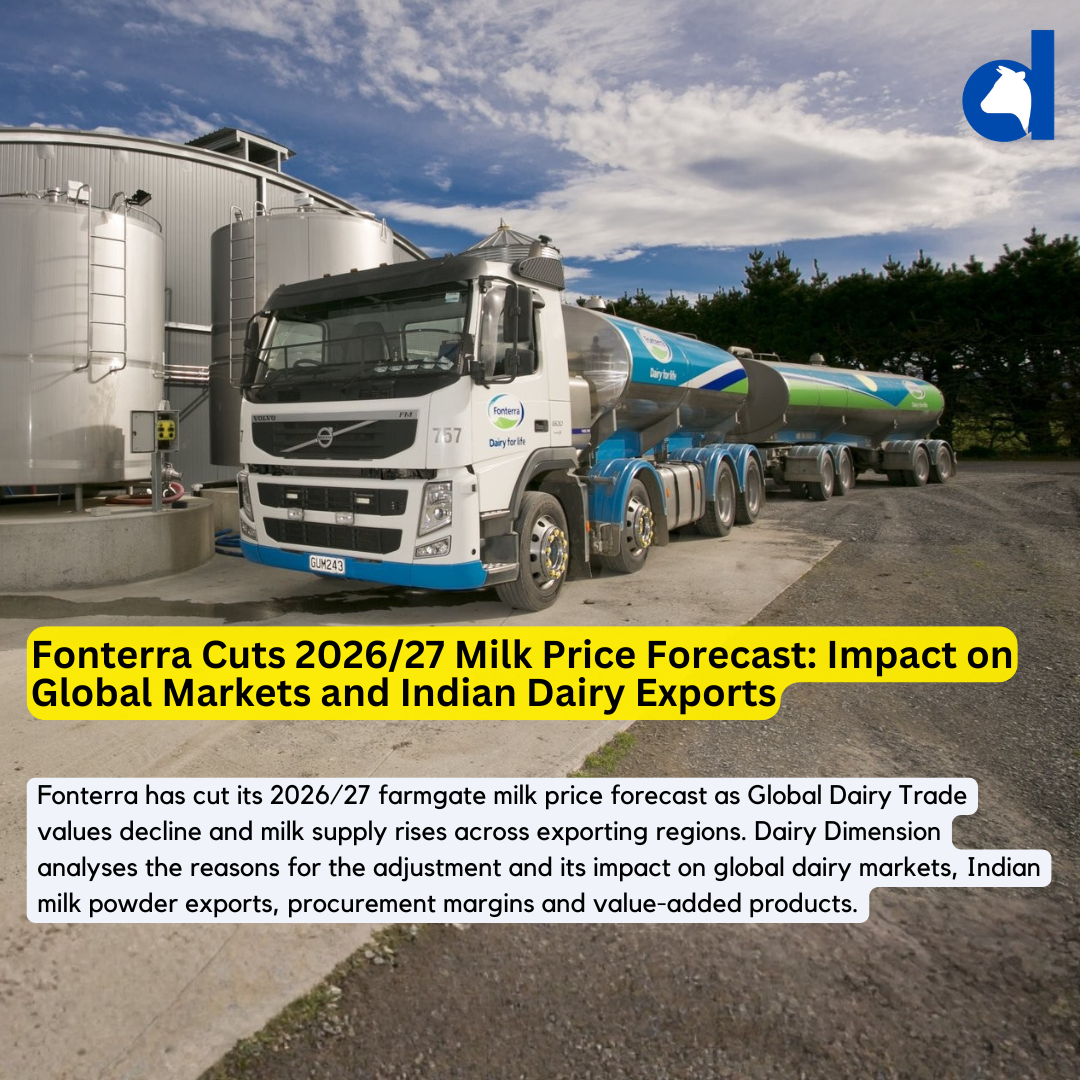
The New Zealand cooperative’s early-season price revision reflects falling Global Dairy Trade values, stronger milk production in major exporting regions and uncertainty over future demand. For India, the correction could place pressure on commodity dairy exports while strengthening the case for value-added and differentiated products.
Fonterra has reduced its forecast farmgate milk price for the 2026/27 season from NZ$9.75 to NZ$9.25 per kilogram of milk solids, following a sharp decline in the dairy commodity prices that underpin its milk pricing model.
The New Zealand cooperative has also narrowed its forecast range from NZ$8.00-NZ$11.00 per kgMS to NZ$8.00-NZ$10.50 per kgMS. Fonterra said prices across the reference products used to calculate the farmgate milk price had fallen by 11 per cent since the opening forecast was announced in late May.
The revision comes at an important point in the international dairy cycle. Milk production is increasing across key exporting regions, while buyers appear less willing to secure large volumes at previously prevailing prices.
For global dairy markets, the adjustment is a clear signal that supply is presently expanding faster than demand. For Indian dairy exporters, particularly those handling milk powders and bulk dairy ingredients, the development could mean stronger price competition and tighter margins.
Global Dairy Trade decline triggers forecast revision
The most immediate reason for Fonterra’s decision is the weakness recorded across recent Global Dairy Trade auctions.
At GDT Event 407 on 7 July 2026, the overall GDT Price Index declined by 4.9 per cent. Whole milk powder, one of the most influential products in New Zealand’s dairy export portfolio, fell by 4.4 per cent to an average of US$3,425 per tonne. Skimmed milk powder declined by 7 per cent to US$3,135 per tonne.
These declines matter because Fonterra’s farmgate milk price is linked to the expected earnings generated from converting raw milk into internationally traded commodities.
When the export values of whole milk powder, skimmed milk powder, butter and anhydrous milk fat decline, the revenue available to support payments to farmer suppliers also weakens.
The forecast revision is therefore not simply a response to one poor auction. It represents a reassessment of the export returns likely to be generated over the season.
Why has Fonterra adjusted the milk price?
Stronger milk production in exporting regions
Fonterra has pointed to higher milk production across major dairy-exporting regions compared with the previous year.
An increase in milk availability leads processors to produce larger volumes of storable commodities such as milk powders, butter and cheese. Unless import demand rises at the same pace, additional production results in greater competition between exporters.
This shifts negotiating power towards buyers and places downward pressure on international prices.
Softer global buying activity
The fall in GDT values also suggests that buyers are adopting a more cautious purchasing strategy.
Major importers may delay tenders when they expect prices to weaken further. Others may meet short-term requirements from existing inventories rather than committing to new contracts.
This can create a cycle in which lower buying activity depresses prices, while expectations of further reductions encourage buyers to remain on the sidelines.
Demand from China, South-East Asia, the Middle East and North Africa will remain central to the global dairy industry forecast for the remainder of the season.
Exposure from an uncontracted sales book
Fonterra has indicated that it remains early in the production season and that much of its 2026/27 sales book is yet to be contracted.
That exposes the cooperative to future market movements. Lowering the forecast at an early stage allows Fonterra to reflect current dairy market conditions before a greater proportion of production is sold.
The decision may therefore be viewed as a prudent risk-management measure. It reduces the possibility of maintaining an opening forecast that later proves inconsistent with actual export earnings.
Whole milk powder remains a critical indicator
Whole milk powder has a particularly significant role in New Zealand’s dairy economy.
New Zealand is one of the world’s leading suppliers of WMP, and prices discovered through GDT influence negotiations across many importing markets. A sustained reduction in WMP prices can consequently affect dairy exporters well beyond New Zealand.
Cheaper New Zealand-origin powder may force suppliers from Europe, the United States, Australia, South America and India to reconsider their export quotations.
Impact on the global dairy market
Fonterra’s revised forecast does not directly determine milk prices in other countries. However, it provides a strong indication of the revenue environment facing export-oriented dairy processors.
Greater competition among exporters
Exporters may have to reduce quotations or accept lower margins to retain customers in price-sensitive markets.
This is particularly relevant for standardised commodities where buyers can switch between suppliers with relatively little product differentiation.
Processors with efficient plants, lower production costs, favourable exchange rates and established customer relationships will be better positioned to manage the downturn.
Lower ingredient costs for importing countries
Countries dependent on imported milk powder, butterfat and dairy ingredients could benefit from the decline.
Food manufacturers producing bakery products, confectionery, recombined milk, beverages and nutritional formulations may see an improvement in ingredient economics.
However, the final benefit will depend on currency movements, freight costs, tariffs and local distribution expenses.
Pressure on farm profitability
If weaker commodity prices continue, milk processors in major exporting countries may eventually reduce farmgate milk payments.
Lower farmer returns can affect spending on feed, herd expansion, farm infrastructure and productivity improvement. Over time, this may slow milk production and help rebalance the market.
Such supply adjustments usually occur with a delay, which means international dairy prices may remain under pressure before production responds.
El Niño could alter the market direction
Despite the present weakness, Fonterra has cautioned that a possible El Niño weather pattern could affect milk supply as the season progresses.
Dry conditions in pasture-based dairy regions can reduce grass growth and constrain milk collections. A significant weather-related decline in New Zealand or Australia could tighten global supply and support a recovery in commodity values.
This risk helps explain why Fonterra has retained a relatively wide forecast range.
The lower midpoint reflects current market weakness, while the range acknowledges that weather, import demand, exchange rates and geopolitical developments could alter the outlook.
What the correction means for Indian dairy exports
India is the world’s largest milk producer, but only a relatively small share of its milk output enters international trade. Domestic consumption continues to absorb most of the country’s production.
During 2024/25, India exported 113,350 tonnes of dairy products valued at US$492.86 million, according to APEDA. The UAE, Saudi Arabia, Bahrain, the United States and Egypt were among the leading destinations.
The decline in global commodity prices presents both challenges and selective opportunities for the Indian dairy industry.
Milk powder exporters could face margin pressure
Indian skimmed milk powder and whole milk powder exporters are likely to face stronger competition if New Zealand commodity prices continue to fall.
The viability of Indian powder exports depends on the relationship between domestic milk procurement prices and international product realisations.
When global prices are strong, exports can provide an outlet for seasonal surpluses. When international prices fall while Indian raw milk costs remain firm, export margins quickly narrow.
In such conditions, Indian dairies may find the domestic market more attractive than bulk exports.
Domestic procurement costs may not fall quickly
Indian milk procurement prices are influenced by several local factors, including:
- Feed and fodder costs
- Seasonal milk availability
- Competition between cooperatives and private dairies
- Festival demand
- Fat and solids content
- State-level market conditions
These factors mean domestic milk prices may not immediately respond to a fall in GDT values.
Indian processors could therefore face a situation in which their raw material costs remain elevated while global powder prices weaken. This would reduce export competitiveness and place pressure on processing margins.
Powder inventories could rise
Dairies holding skimmed milk powder stocks may find it more difficult to secure remunerative export orders.
If inventories increase, processors may face greater storage and working-capital costs. Some may reduce powder production or divert milk towards products with stronger domestic demand.
These could include ghee, paneer, curd, cheese, flavoured milk, ice cream and traditional dairy products.
This shift may support value-added dairy products, but it could also intensify competition within the domestic market.
Where India may remain competitive
India is unlikely to build a sustainable dairy export strategy by competing only on the price of standard commodities.
Its stronger opportunities lie in differentiated products and markets where factors other than bulk commodity pricing influence purchasing decisions.
Ghee and ethnic dairy products
Indian ghee benefits from established demand across Gulf countries, North America and other diaspora markets.
Purchasing decisions in these categories are influenced by flavour, cultural familiarity, product origin, packaging and brand trust. This provides some insulation from movements in global milk powder prices.
International butterfat prices will still affect the market, but branded ghee is generally less exposed than undifferentiated bulk powder.
Traditional and value-added dairy products
Paneer, dairy sweets, khoa-based products and specialised buffalo milk products offer greater scope for differentiation.
These categories allow Indian companies to compete on authenticity, composition and convenience rather than relying solely on low prices.
Regional market access
India has a geographical advantage in supplying parts of South Asia, the Middle East and East Africa.
Shorter shipping distances can reduce delivery times and freight exposure, particularly for products with limited shelf life or customers requiring frequent shipments.
Customised packaging and food-service formats
Indian processors can also strengthen their position through smaller retail packs, food-service formats and market-specific formulations.
Flexibility may provide an advantage over exporters focused largely on bulk shipments.
Implications for Indian dairy cooperatives
The change in global market conditions is particularly relevant for dairy cooperatives managing seasonal surpluses.
Exports can support domestic milk procurement when powder stocks rise. However, this outlet becomes less effective when international prices fall below export parity.
Cooperatives may therefore need to manage:
- Milk procurement volumes
- Powder production
- Inventory exposure
- Product diversification
- Export contracting
- Working-capital requirements
The challenge will be to maintain farmer confidence while preventing excessive accumulation of low-margin commodities.
Private dairies with flexible product portfolios may be able to redirect more milk into branded consumer categories. Cooperatives with large powder capacities may need to place greater emphasis on demand planning and value-added processing.
What Indian exporters should monitor
The next phase of the market will depend on three broad indicators.
The first is milk production in New Zealand, Europe, the United States and other exporting regions. Continued growth would maintain pressure on commodity prices.
The second is import demand, particularly from China and major buyers in Asia and the Middle East. A return of large-volume purchasing could provide support to the market.
The third is weather. El Niño-related production disruption could tighten milk availability and reverse part of the recent decline.
Currency movements will also influence competitiveness. A weaker New Zealand dollar could allow exporters there to remain aggressive in US dollar terms, while movements in the Indian rupee would affect returns for domestic exporters.
Dairy Dimension analysis
Fonterra’s forecast reduction is best understood as an early correction to a weaker export revenue outlook rather than evidence of a structural collapse in the global dairy market.
Reference commodity prices have declined substantially, milk production is increasing in major exporting regions and a significant part of the new season’s sales remains exposed to future market conditions. Under these circumstances, reducing the midpoint from NZ$9.75 to NZ$9.25 per kgMS is commercially consistent with the market signals now available.
For India, the immediate implications are more challenging for standard milk powders than for differentiated dairy products.
Bulk SMP and WMP exports may become less attractive if domestic milk procurement prices remain firm. Ghee, traditional products, buffalo milk specialities and branded value-added categories are likely to offer greater resilience.
The broader lesson for the Indian dairy sector is clear. Export growth cannot depend only on temporary shortages or high commodity prices.
A more durable strategy will require investment in product differentiation, food safety, traceability, efficient processing, destination-specific certification and stronger distribution in premium regional and diaspora markets.