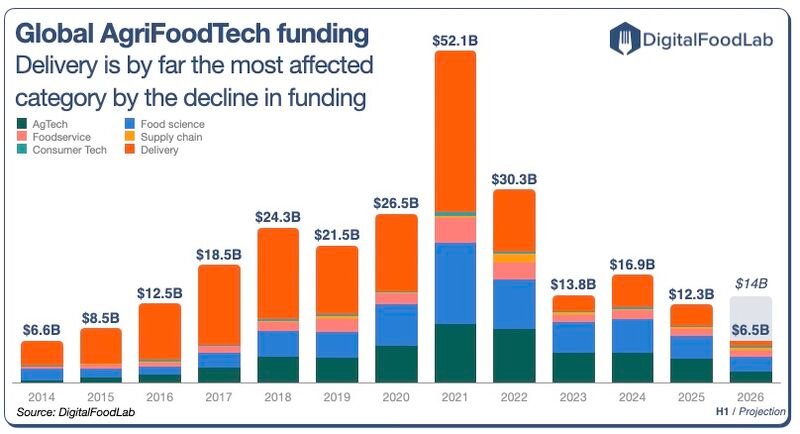
Global food technology investment is undergoing a significant shift, with funding increasingly moving away from delivery-focused businesses toward agricultural technology and food science. According to DigitalFoodLab’s Global FoodTech Investment Report 2026, delivery accounted for just 13% of global AgriFoodTech funding in the first half of 2026, while AgTech and Food Science together represented 64%.
The changing investment landscape highlights how investors are reassessing opportunities across the food value chain, from agricultural productivity and ingredient innovation to health-focused nutrition. Although the overall funding environment remains challenging, several segments continue to attract attention for their potential to address industry needs and changing consumer preferences.
FoodTech Funding Remains Under Pressure
The global FoodTech investment market continues to face headwinds. Startups raised $12.3 billion in 2025, representing a 27% decline compared with 2024. While early signs of improvement appeared in 2026, a sustained recovery had not yet been established at the time of the report.
Despite the difficult environment, the distribution of funding reveals a notable change in investor priorities. Delivery businesses, which once attracted more than half of global AgriFoodTech investment, accounted for only 13% in the first half of 2026.
Meanwhile, AgTech and Food Science collectively captured 64% of funding during the same period. This shift suggests that investment is increasingly directed toward technologies and businesses addressing production challenges, agricultural efficiency, food formulation and ingredient development.
For food manufacturers and ingredient companies, these developments may create opportunities to collaborate with startups developing solutions that are more closely connected to sourcing, production and product innovation.
Health-Focused Nutrition Attracts Attention
Health-focused nutrition is one of the areas highlighted in the report. This category includes better-for-you food brands, supplements and services responding to evolving consumer needs.
Interest in healthy ageing and changing dietary preferences, including those associated with GLP-1 medications, is creating new opportunities for food businesses. Companies are exploring products and services that align with consumers’ growing attention to nutrition, health and wellbeing.
For food manufacturers, these trends can influence product development, ingredient selection and formulation strategies. Businesses that can respond to changing nutritional preferences while maintaining product quality, affordability and consumer trust may find opportunities for growth.
However, commercial success will depend on credible product benefits, regulatory compliance and sustained consumer demand rather than investment interest alone.
AgTech Focuses on Productivity and Resilience
Agricultural technology remains another important area for investment. Solutions addressing labour shortages, production efficiency and crop performance are gaining attention as agricultural businesses face pressure to produce efficiently and manage operational risks.
Technologies that improve farm productivity, optimise resource use and support more resilient agricultural systems can benefit farmers and businesses further along the food supply chain.
For the dairy industry, developments in agricultural productivity can have implications for feed availability, forage production, farm operating costs and the reliability of raw material supplies. Technologies that improve the efficiency and resilience of feed production may be particularly relevant to dairy farmers and processors seeking to manage costs and maintain consistent milk production.
As investors assess opportunities in AgTech, businesses offering measurable improvements to agricultural operations may be better positioned to demonstrate their commercial value.
Novel Ingredients Move Closer to Commercialisation
Food science and novel ingredients represent another area to watch. The report highlights innovations approaching commercialisation, where product launches, customer adoption and industrial partnerships could help support further investment.
For food and ingredient companies, these developments create potential opportunities to explore new formulations, alternative ingredient sources and differentiated products. However, the transition from promising research to commercial success often requires investment in manufacturing capacity, product validation, regulatory approvals and reliable supply chains.
Partnerships between startups and established manufacturers can help bridge this gap by providing access to production infrastructure, technical expertise and customer networks.
The pace of commercial adoption will remain an important factor in determining which innovations attract additional funding.
What the Investment Shift Means for Food Businesses
DigitalFoodLab’s findings indicate that the FoodTech investment landscape is changing even as total funding remains under pressure. The reduced share of delivery businesses and the growing combined share of AgTech and Food Science point to a stronger focus on solutions addressing food production, agricultural resilience and ingredient innovation.
For dairy processors, ingredient suppliers and food manufacturers, these trends offer useful signals for evaluating potential partnerships and emerging technologies. Agricultural productivity solutions may help address upstream challenges, while food science innovations could open new possibilities for product development and ingredient sourcing.
The next phase of FoodTech investment will depend not only on investor confidence but also on startups’ ability to demonstrate commercial traction, deliver measurable value and scale their solutions.
As the sector evolves, companies that connect technological innovation with practical needs across the food value chain could play an important role in shaping the industry’s next stage of growth.