Global Dairy Trade Undergoes Major Shift as EU Loses Share and Cheese Demand Accelerates
The global dairy trade landscape is entering a new phase, marked by shifting production dynamics, diversified import demand, and the growing strategic importance of cheese and whey markets.
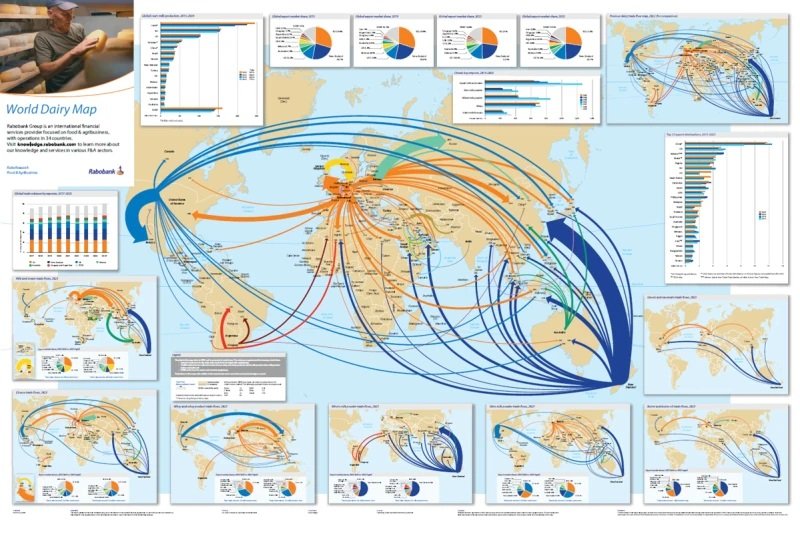
For decades, the European Union was the dominant force in international dairy trade. However, its share of global dairy exports has gradually declined from nearly 30% in 2017 to approximately 27% in 2025, creating opportunities for competing exporters to strengthen their positions.
EU Faces Structural Constraints
European dairy production is increasingly constrained by several long-term factors, including:
- 🌍 Stricter environmental and sustainability regulations
- 💰 Rising operational and compliance costs
- 👴 An ageing dairy farmer population
- 📉 Limited expansion opportunities in key production regions
While these measures support environmental objectives, they are also placing a structural ceiling on future milk production growth across Europe.
As a result, global dairy trade is becoming increasingly diversified, with other exporting nations stepping in to fill the supply gap.
United States and South America Gain Momentum
The United States has continued to strengthen its position in global dairy trade, increasing its share to approximately 13.5%.
Meanwhile, South American exporters, particularly Argentina and Uruguay, have benefited from:
- Lower production costs
- Competitive feed availability
- Favorable production conditions
- Increasing investment in processing infrastructure
Together, Argentina and Uruguay now account for approximately 4.3% of global dairy trade, further intensifying competition in international markets.
Global Demand Moves Beyond China
A major development reshaping dairy trade is the gradual diversification of import demand away from China.
Although China remains the world’s largest single-country dairy importer, imports of liquid milk, cream, and milk powders have fallen sharply since peaking in 2021.
The decline is largely driven by China’s efforts to increase domestic milk production and improve self-sufficiency.
This shift has encouraged exporters to focus on alternative high-growth regions, including:
- 🌏 Southeast Asia
- 🇧🇷 Latin American markets, particularly Brazil
- 🌍 Middle Eastern countries with structural import dependence
Notably, Brazil has reportedly doubled its dairy imports since 2022, emerging as an increasingly important destination for global dairy exporters.
The diversification of demand is reducing dependence on a single buyer and helping create a more balanced global dairy trade environment.
Cheese Emerges as the New Growth Engine
One of the most significant drivers of global dairy trade growth has been the remarkable expansion of the cheese sector.
Global cheese trade has increased by approximately 40% since 2017, supported by changing consumer preferences, rising incomes, and growing demand for convenience foods and foodservice products.
Both the United States and Argentina have reportedly doubled cheese exports over this period, prompting substantial investments in new processing capacity.
Whey Becomes a Strategic Profit Driver
The rapid growth of cheese production is also transforming the economics of dairy processing through increased whey availability.
Historically considered a low-value byproduct, whey has evolved into one of the industry’s most valuable nutritional ingredients.
Products such as:
- 💪 Whey Protein Concentrate (WPC)
- 🏋️ Whey Protein Isolate (WPI)
are experiencing strong demand from several rapidly growing sectors:
- Sports and active lifestyle nutrition
- Clinical and medical nutrition
- Healthy ageing solutions
- Weight management products, including those associated with GLP-1 medications
The growing popularity of high-protein diets and muscle preservation strategies is significantly increasing the value of whey streams and altering the profitability dynamics of modern dairy processing.
A New Era for Global Dairy Markets
The global dairy industry is increasingly moving toward a more diversified and competitive structure.
Key trends likely to shape future market developments include:
- 🌍 Greater regional diversification of import demand
- 🧀 Continued expansion of cheese production and trade
- 💪 Rising strategic importance of whey ingredients
- ⚖️ Intensifying competition among major exporting regions
- 🌱 Balancing sustainability objectives with production growth
As the industry adapts to changing trade flows and evolving consumer demand, exporters that successfully align production, processing investments, and value-added product strategies may be best positioned to capture future growth opportunities.