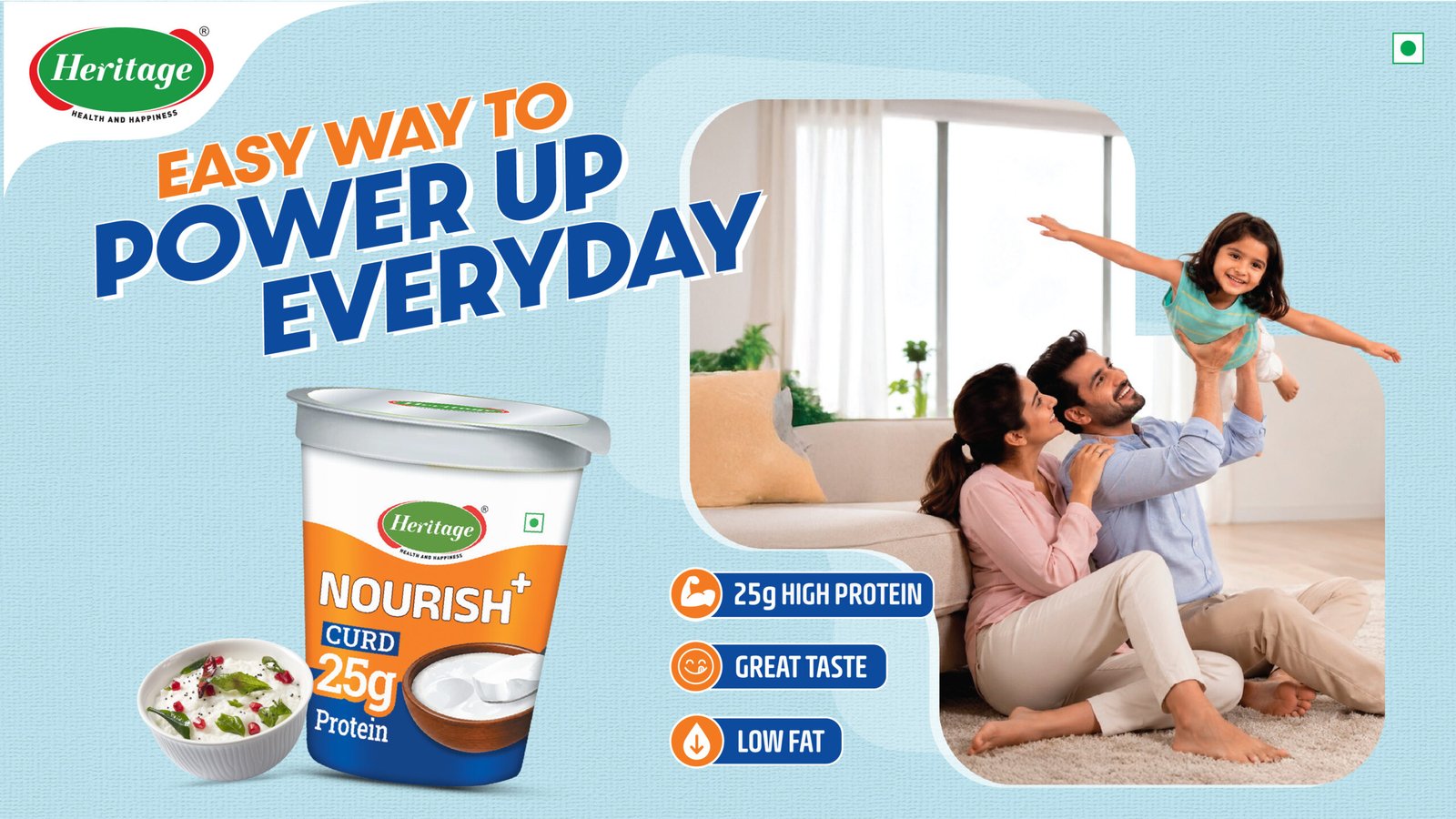
Hyderabad: India’s fast-developing high-protein dairy category has gained another mainstream entrant, with Heritage Foods launching Nourish+ High Protein Curd, a 400g product containing 25g of protein and priced at ₹75.
The launch, announced on 19 August 2026, extends Heritage Foods’ Nourish+ portfolio beyond high-protein paneer and protein-rich milk and signals a broader change taking place across the Indian dairy industry. Protein, once marketed primarily through supplements, powders and products aimed at gym-goers, is increasingly being incorporated into familiar foods such as milk, paneer, curd, yoghurt, lassi and buttermilk.
For India’s dairy sector, this represents more than another premium product category. It creates an opportunity to combine the familiarity of traditional dairy with functional nutrition, while potentially increasing value realisation from every litre of milk.
Heritage’s new curd delivers 25g protein in a 400g cup, equivalent to about 6.25g per 100g. The company says it has focused on retaining the rich and creamy characteristics consumers associate with conventional curd, addressing one of the persistent challenges in high-protein foods: balancing nutritional enhancement with taste and texture.
The product can be consumed directly or used in everyday Indian meals such as curd rice and raita. That versatility is strategically important. Rather than asking consumers to develop an entirely new eating occasion, Heritage is attempting to insert additional protein into an established one.
This philosophy is captured in the Nourish+ proposition: “Don’t Break Up With What You Love. Just Add Nourish+.”
From paneer to curd, Heritage builds a protein platform
Nourish+ High Protein Curd is the third important component of Heritage’s emerging protein-focused dairy platform.
The company’s Nourish+ High Protein Paneer provides 60g protein per 240g pack, while Nourish+ Protein Rich Milk provides 18g per 500ml pack. Heritage’s FY26 disclosures also highlighted Nourish+ High Protein Paneer among its innovation-led value-added product launches, alongside products including Livo Yogurts and Sampurna A2 Curd.
This matters because Heritage is not merely developing a high-protein SKU. It is gradually creating a high-protein dairy portfolio spanning multiple consumption occasions.
Milk can address breakfast and beverage occasions, paneer can enter lunch and dinner, while curd can potentially span meals, snacks and accompaniments.
Brahmani Nara, Executive Director, Heritage Foods, said:
“Our food habits are deeply rooted in the cuisines and tastes we have grown up with, and dairy has always been an important part of that routine. With Nourish+, our endeavour is to make it simpler for families to add more protein to their everyday diets, without asking them to change the foods they love or compromise on taste.”
She added that with high-protein paneer, protein-rich milk and now high-protein curd, Heritage is building a portfolio that brings additional protein into familiar dairy formats while making better nutrition more convenient and accessible.
The 400g Nourish+ High Protein Curd is priced at ₹75 and is being distributed through leading quick-commerce platforms, modern trade, Heritage Happiness Points and selected premium general trade stores.
India’s high-protein dairy shelf is getting crowded
Heritage is entering a category where several major Indian dairy businesses are already experimenting with protein density, convenience and premium nutrition.
Here is a snapshot of selected recent products and strategic moves in India’s high-protein dairy market:
| Company / brand | Product or portfolio | Protein proposition | Recent development / significance |
|---|---|---|---|
| Heritage Foods | Nourish+ High Protein Curd | 25g / 400g | Launched August 2026 at ₹75. Extends Nourish+ into curd. |
| Heritage Foods | Nourish+ High Protein Paneer | 60g / 240g | Part of the company’s FY26 innovation-led value-added dairy portfolio. |
| Heritage Foods | Nourish+ Protein Rich Milk | 18g / 500ml | Builds the Nourish+ proposition around an everyday milk occasion. |
| Amul | High Protein Dahi | 25g / 400g | High-protein probiotic dahi is already part of Amul’s expanding protein portfolio. |
| Amul | High Protein Milk | 35g / 250ml | One of several protein-focused dairy formats in Amul’s portfolio. |
| Amul | High Protein Paneer | 60g / 200g at 2025 launch | Introduced alongside a 10g protein chocolate ice cream bar and 10g protein vanilla milkshake in May 2025. |
| Mother Dairy | Promilk | 40g / litre | Launched March 2025 as the first product under its Pro platform, with 30% more protein than its referenced standard milk. Mother Dairy also indicated plans for protein-rich paneer and curd. |
| Milky Mist | Skyr, Greek yoghurt and protein-focused products | High-protein / premium positioning | Milky Mist’s current new-arrival portfolio includes Skyr and Greek yoghurt, while the company has identified premium and high-protein products as growth opportunities. |
| Parag Milk Foods | Pride of Cows Paneer / Greek Yoghurt | 45g paneer; 8g Greek yoghurt, according to its 2025 disclosure | Part of a broader push towards health, premiumisation and value-added dairy. |
The table is a selected market snapshot rather than an exhaustive catalogue. Pack formulations, prices and availability can change, so current labels should be used for direct nutritional comparison.
The bigger trend: protein is becoming an everyday dairy attribute
Perhaps the most important development is not simply that more high-protein products are being launched. It is where protein is appearing.
A few years ago, an Indian consumer actively seeking additional protein was more likely to encounter whey powder, a protein bar or a specialist fitness drink.
Now the same nutritional proposition can increasingly be found in a bowl of dahi, a glass of milk, paneer, buttermilk, lassi, Greek yoghurt, Skyr or even ice cream.
That changes the addressable consumer dramatically.
A curd positioned around protein does not have to be consumed only after exercise. It can accompany dal-rice at lunch, become raita at dinner, form part of breakfast or work as a convenient snack.
This is particularly significant in India because dairy already enjoys widespread cultural familiarity.
Why high-protein curd could be strategically important
Curd offers an interesting vehicle for protein enrichment because it requires comparatively little behavioural education. Consumers already understand what curd is, how it tastes and where it fits into a meal.
That creates several advantages for dairy processors.
First, it lowers the behavioural barrier. Consumers do not necessarily need to learn how to use a new nutrition product.
Second, it broadens the protein consumer beyond fitness enthusiasts. Families, professionals, older consumers and increasingly nutrition-conscious households can all potentially participate in the category.
Third, dairy protein provides a complete amino-acid profile. Milk naturally contains high-quality proteins, principally casein and whey proteins. Protein contributes to maintenance and growth of muscle mass, although overall dietary needs vary according to age, body size, activity, health status and total diet.
Fourth, curd offers multiple eating occasions. Unlike a specialist shake consumed at a particular time, curd can move between meals, snacks and cooking applications.
And finally, high-protein variants give dairy processors another route towards value-added dairy products, premiumisation and milk valorisation rather than competing exclusively on commodity milk volumes and prices.
Prashant Tripathi: the opportunity is milk valorisation
The development closely echoes an observation previously made to Dairy Dimension by Prashant Tripathi, Director, Market Access at Jordbrukare, while discussing the global protein boom.
“India’s dairy sector must shift its mindset from milk as a commodity to milk as a functional ingredient. The protein boom offers a real chance for value creation through yoghurt, whey, fortified milk and more. The key is milk valorisation, creating more value per litre, rather than blindly following the milk pricing of leading brands.”
Tripathi further argued that processors investing in value-added protein products would be better positioned to participate in the health-driven consumption wave developing among India’s urban and nutrition-conscious consumers.
That observation is increasingly visible on the retail shelf.
Protein plus convenience could become a powerful combination
The rise of quick commerce adds another dimension to the category.
High-protein dairy products tend to appeal strongly to urban consumers who value convenience, nutrition and portion-controlled formats. Quick-commerce platforms allow manufacturers to place relatively specialised products in front of precisely those consumers without immediately requiring the physical distribution density demanded by mass-market milk.
This may help explain why high-protein products are proliferating across smaller packs, premium yoghurts, shakes, paneer and functional dairy formats.
For processors, the opportunity is therefore not simply nutritional innovation. It is the intersection of nutrition + premiumisation + convenience + digital distribution.
India is not alone: high protein is becoming a global dairy battleground
The movement is part of a wider global shift towards protein-rich foods.
Recent international consumer trends show high-protein yoghurts and drinks continuing to attract demand. In Australia, for example, protein-rich yoghurts and beverages have emerged as an important growth area even as consumers remain cautious about discretionary spending.
The wellness trend is also spreading into categories historically associated primarily with indulgence. Ice cream manufacturers globally are experimenting with added protein and other nutritional attributes as health and wellness expectations reshape food innovation.
Meanwhile, within India, recent consumer reporting points towards growing interest in protein, gut health, Greek yoghurt, better-for-you snacks and cleaner nutritional propositions.
This suggests that high protein is evolving from a standalone product claim into a broader food-development platform.
But more protein alone will not guarantee success
There is an important caution for India’s dairy industry.
Consumers may initially discover a product because the pack says “25g protein” or “high protein”, but repeat purchase will depend on considerably more.
Taste, texture, affordability, ingredients, sugar levels, calories, digestive comfort, convenience and availability all influence whether a functional dairy product moves from trial to routine consumption.
This is particularly relevant for curd.
Traditional dahi is a relatively inexpensive household staple. A high-protein version therefore has to communicate enough additional value to justify its premium while remaining close enough to conventional curd in taste and functionality.
That could ultimately separate successful protein brands from short-lived nutritional launches.
What comes next for India’s dairy industry?
The competitive direction is becoming clearer.
Amul already has an extensive protein portfolio spanning milk, paneer, dahi, buttermilk and beverages. Mother Dairy has established its Pro platform. Milky Mist is pushing premium products such as Skyr and Greek yoghurt, while Heritage is expanding Nourish+ across familiar staples.
The next phase of competition could therefore move beyond simply claiming “high protein”.
Consumers may increasingly compare protein per serving, protein per calorie, protein per rupee, sugar content, fat, probiotics, ingredient lists and taste.
That would push dairy technology India towards a more sophisticated form of nutritional product development.
It could also create opportunities further upstream. As demand expands, Indian processors may need more sophisticated milk fractionation, membrane filtration, whey utilisation, protein concentration and formulation capabilities.
India’s protein opportunity, in other words, may eventually become as much a dairy processing and ingredient story as a consumer-brand story.
From more milk to more value from milk
Heritage Foods’ Nourish+ High Protein Curd is therefore significant beyond its 400g cup.
It represents an emerging direction for the Indian dairy industry in which familiar products are being redesigned to deliver additional nutritional functionality without asking consumers to abandon established eating habits.
The commercial opportunity is equally compelling. India’s dairy sector has spent decades expanding milk production, procurement and distribution. The next value-creation cycle could increasingly depend on extracting more nutritional and commercial value from that milk through differentiated products.
High-protein curd, milk and paneer are early manifestations of that transition.
The winners will probably not be determined by who prints the largest protein number on the pack. They will be the processors that can combine credible nutrition, enjoyable taste, familiar formats, sensible pricing and mass accessibility.
For India’s dairy market, the protein race has only just begun.