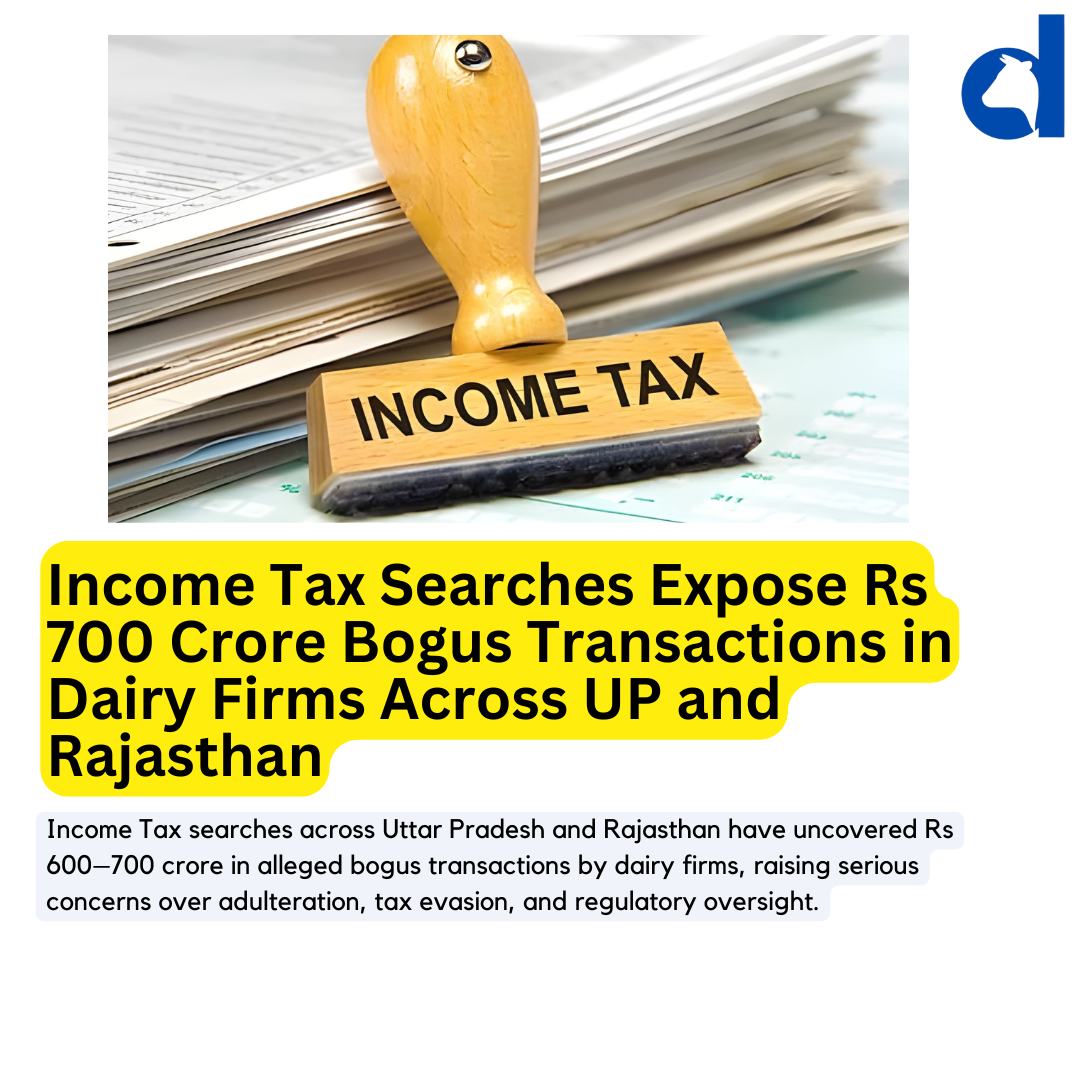
A series of coordinated searches by India’s tax authorities across Uttar Pradesh and Rajasthan has lifted the lid on structural vulnerabilities within parts of the country’s regional dairy processing ecosystem, exposing alleged bogus transactions worth ₹600–700 crore and raising broader questions around compliance, quality assurance and market discipline in the sector.
The operation, led by the Income Tax Department, spanned more than 35 locations and involved over 200 officials, marking one of the most extensive enforcement actions targeting dairy businesses in recent years. Investigators focused on mid-sized, privately owned dairy processors concentrated in ghee and fat-based product categories, particularly in clusters around Agra, Dholpur, Sirsaganj, Bikaner and Jodhpur.
📍 Companies/Groups Targeted in Raids
- Dauji Milk Food Pvt Ltd — Part of the Dauji Group operating in the Agra-Bharatpur region; multiple premises (including a factory in Dausa) were searched, and product samples were sent to the FSSAI lab for testing after being found substandard.
- Poddar Milk Products Pvt Ltd — A regional dairy processor from the Sirsaganj area.
- Bhole Baba Milk Food Industries Ltd — A key unit in the Bhole Baba Group, with searches conducted on business and residential premises tied to the brand.
- Bhole Baba Milk Food Industries (Dholpur) Pvt Ltd — A related Bhole Baba Group entity in Dholpur.
- Ashish Agarwal Group — A business group based in Bikaner (Rajasthan) whose dairy operations were among those searched.
- Malani Group — A Jodhpur-based business whose premises were also included in the search operations.
Allegations Point to Systemic Accounting Irregularities
According to officials familiar with the investigation, preliminary findings suggest the widespread use of bogus billing and fictitious transactions, where purchases and sales were recorded on paper without corresponding physical movement of goods. Such practices are typically used to inflate costs, suppress taxable profits and generate ineligible tax credits.
In several instances, investigators reportedly found that low-grade or adulterated fat products were accounted for as high-value pure ghee, allowing processors to benefit simultaneously from lower production costs and premium pricing on their books. This dual distortion — of both quality representation and financial reporting — has placed the spotlight on a long-suspected grey zone within parts of India’s informal-to-semi-formal dairy economy.
While final assessments are still underway, tax officials indicated that the ultimate quantum of evasion could exceed initial estimates once seized documents, digital records and inter-company linkages are fully analysed.
Food Safety and Tax Enforcement Converge
Crucially, the investigation has moved beyond accounting alone. Samples collected from at least one manufacturing unit were tested and found to be substandard, prompting the involvement of the Food Safety and Standards Authority of India. This convergence of food safety enforcement with tax scrutiny reflects a more integrated regulatory approach, particularly in sectors where quality claims and pricing power are closely intertwined.
For the dairy industry, this linkage is significant. Misrepresentation of product quality does not merely constitute a consumer protection issue; it also has direct implications for tax compliance, competition and market fairness.
Why the Ghee Segment Is Under Scrutiny
Ghee remains one of India’s most commercially sensitive dairy products. High demand, wide price dispersion and variable quality standards make it especially vulnerable to adulteration and misclassification. Unlike liquid milk, where procurement volumes and fat content are easier to reconcile, ghee offers greater scope for opacity across sourcing, conversion yields and inventory reporting.
The current investigation underscores how such opacity can be exploited at scale when regulatory oversight, testing capacity and audit trails are weak or fragmented.
Implications for the Wider Dairy Sector
While the searches are limited to specific firms and regions, their implications extend far beyond the entities directly involved.
First, compliance expectations are rising. The action signals that dairy — traditionally viewed as a fragmented, low-risk sector from a tax perspective — is now firmly on the enforcement radar, alongside FMCG and edible oils.
Second, quality assurance is becoming inseparable from financial transparency. Processors making premium claims without robust testing, traceability and documentation face growing regulatory risk.
Third, financing and expansion strategies may tighten. Banks, investors and institutional buyers are likely to increase scrutiny of audit practices, product testing protocols and internal controls, particularly for regional brands seeking to scale nationally.
A Structural Issue, Not an Isolated Case
Importantly, this episode should not be viewed as a commentary on India’s dairy sector as a whole. Large cooperatives and organised private players operate under far stricter procurement, testing and reporting frameworks. Instead, the case highlights a structural fault line within parts of the unorganised and semi-organised processing layer, where weak governance intersects with high-value products and cash-heavy operations.
For policymakers, the message is clear: strengthening laboratory infrastructure, digitising audit trails and aligning food safety enforcement with tax intelligence will be critical to restoring trust and market discipline in these segments.
What Comes Next
In the coming months, the sector will be watching for:
- Final tax assessments and potential prosecution outcomes
- Public food safety actions, including recalls or licence suspensions
- Spillover investigations into allied fat-based food categories
- Shifts in regulatory oversight of regional dairy clusters
Taken together, the raids mark a turning point. They signal a move away from episodic enforcement towards a more systemic effort to clean up compliance, quality and credibility in India’s vast and complex dairy economy.