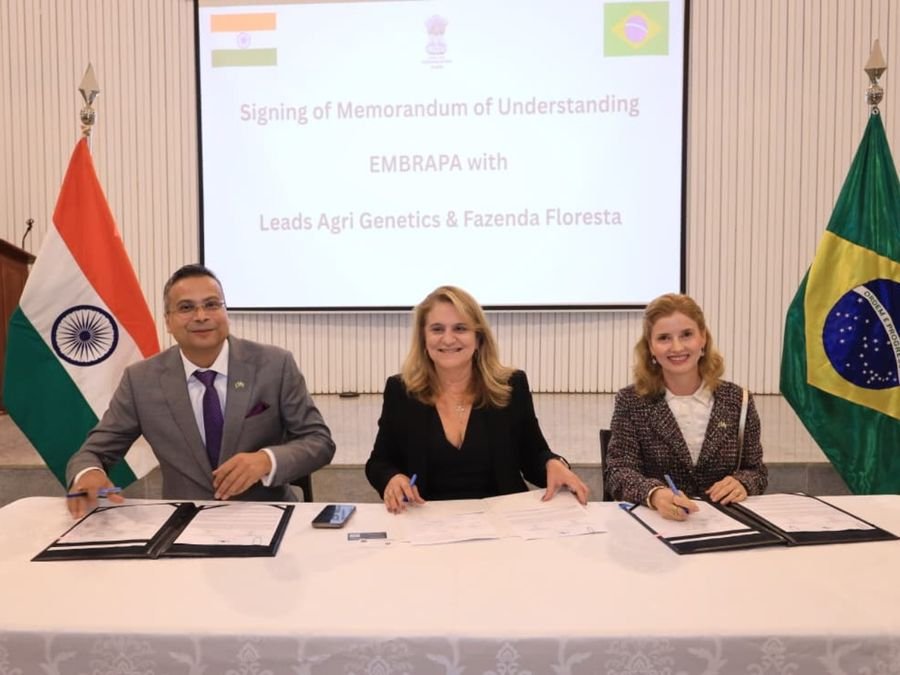
India and Brazil have signed a landmark tripartite Memorandum of Understanding (MoU) to jointly advance dairy cattle and buffalo genomics. The agreement introduces a first-of-its-kind cross-continental genetic improvement programme and signals deeper cooperation between two of the world’s largest dairy-producing nations.
Importantly, this MoU represents the first business-to-government (B2G) collaboration in bovine genomics between India and Brazil. It also marks Embrapa’s first private partnership with an Indian organisation. As a result, the agreement reflects growing alignment on livestock innovation, food security and climate-resilient dairy development.
Institutional Collaboration Across Continents
The MoU and the associated Technical Cooperation Project (PCT) were signed at the Embassy of India in Brasília. The signatories included Brazil’s agricultural research major Embrapa, Fazenda Floresta & DNAMark, and Indian partners Leads Genetics Pvt. Ltd, B.L. Kamdhenu Farms Ltd and Leads Connect Services Pvt. Ltd.
Senior diplomatic and scientific leaders from both countries attended the signing. Their presence underlined the strategic value of the initiative. Moreover, it highlighted the increasing role of structured public–private partnerships in advancing agricultural science and applied innovation.
Genomics at the Core of Dairy Productivity
At the heart of the collaboration lies the establishment of a state-of-the-art Cattle and Buffalo Genomics Laboratory in India. The facility will combine Brazil’s advanced genomic technologies with India’s large dairy population and indigenous breeds.
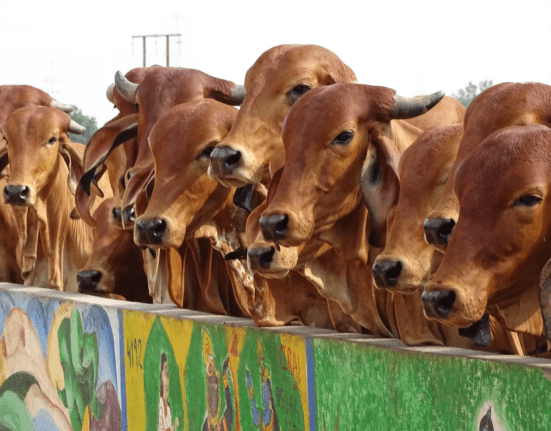
The programme will focus on Bos indicus, Bos taurus and Bubalus bubalis. Through genomic selection, the partners aim to improve milk productivity, reproductive efficiency and heat tolerance. Therefore, the initiative directly addresses key challenges faced by tropical dairy systems, including climate stress and uneven genetic performance.
Uttar Pradesh Chosen for Early Impact
The programme will begin in Uttar Pradesh, India’s largest milk-producing state. This choice allows the project to deliver visible results in a region critical to the national milk supply. Furthermore, it offers an opportunity to demonstrate scalability at an early stage.
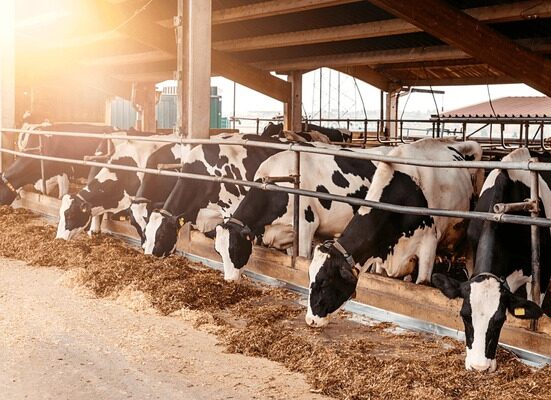
The initiative will operate from B.L. Kamdhenu Farms’ 10,000-head Integrated Model Dairy Farm in Bareilly. The site is evolving into a Centre of Excellence for Indigenous Cattle Genetics and Circular Dairy Economy. It already integrates genomics laboratories, IVF facilities and farmer-linked breeding networks.
Implications for Farmers and the Dairy Sector
Beyond genetics, the collaboration carries broader economic and structural implications. It is expected to strengthen farmer incomes by improving animal performance and herd efficiency. At the same time, it will build domestic scientific capability and reduce long-term dependence on imported germplasm.
For Brazil, the partnership provides a structured route to deploy its tropical dairy genetics in a high-growth market. Meanwhile, India gains access to proven genomic tools that align with its climate and production conditions.
A Strategic Indo–Brazil Dairy Innovation Corridor
Industry observers see the MoU as the foundation of a long-term Indo–Brazil innovation corridor in dairy genomics. The collaboration blends scientific research, private-sector execution and farmer-focused application. As global dairy systems face mounting climate and productivity pressures, such partnerships are likely to shape the next phase of sustainable dairy development.