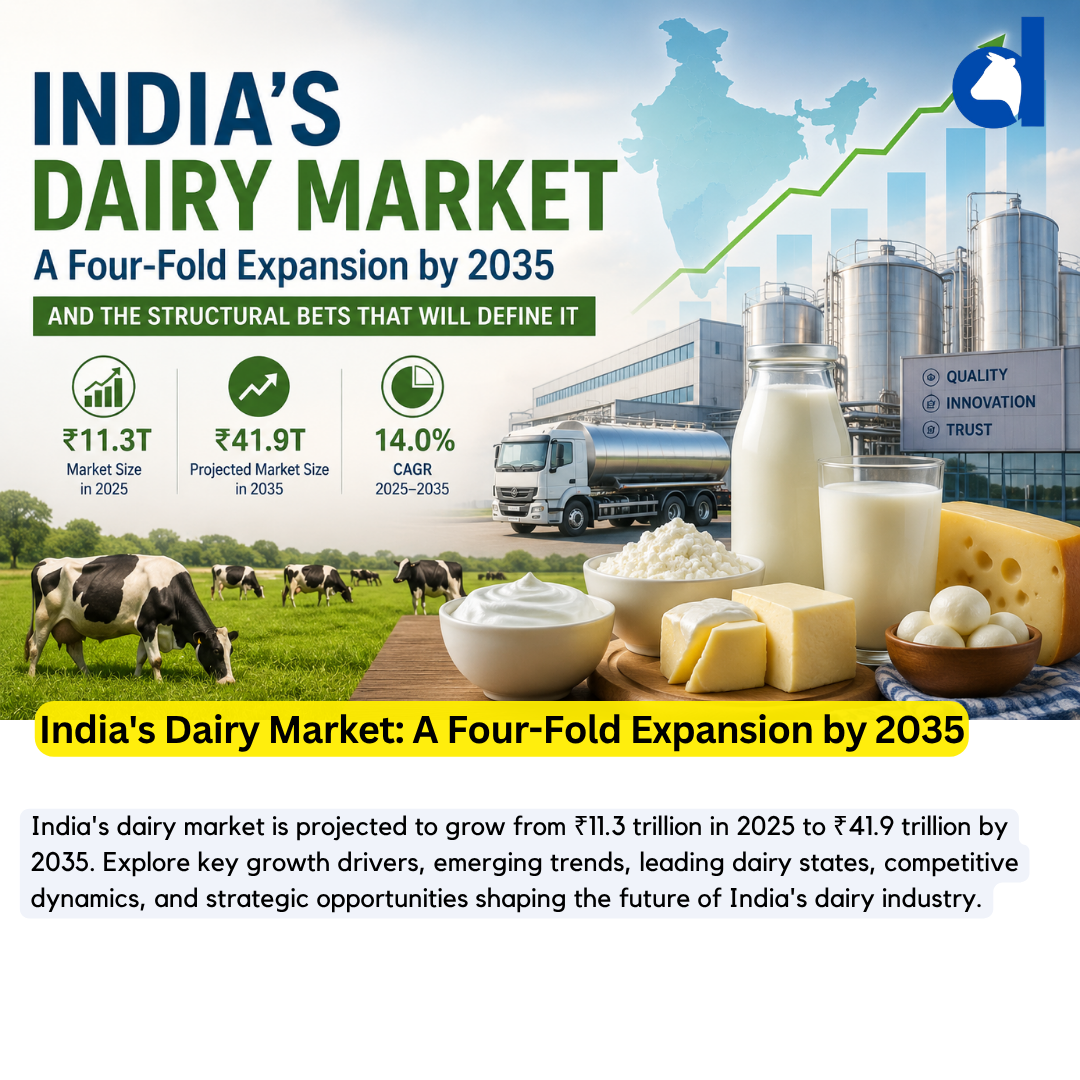
India’s Dairy Market: A Four-Fold Expansion by 2035 — And the Structural Bets That Will Define It
Why growth is accelerating now
Four structural currents are converging. Rising real disposable incomes and a fast-expanding middle class have elevated daily protein expectations. India’s population, now exceeding 1.4 billion, provides a persistent volume floor for all staple dairy categories — milk, paneer, ghee, curd, and butter. Rapid urbanisation is shifting consumption toward packaged and value-added formats. And substantial cold chain investment is extending organised dairy brands into Tier-2 and Tier-3 geographies previously served only by unorganised players.
Government-led programmes — NDDB activities, subsidies for animal husbandry, and producer-company reforms — have materially empowered smallholder milk producers, compressing the cost of organised procurement and enabling cooperative reach at national scale.
“India’s dairy market is not growing uniformly — it is bifurcating. The commodity middle is being squeezed from above by branded value-added products and from below by unorganised farmgate milk. The only durable positions are at the two poles: premium-functional and ultra-low-cost with embedded farmer relationships.”
— Prashant Tripathi, Founder & Director, Jordbrukare India Pvt. Ltd., Kiel / Dehradun
Segment-by-segment growth outlook
Jordbrukare’s segment analysis distinguishes between volume-driven and value-driven growth vectors. The table below maps the six primary segments against their estimated 2025 share, growth momentum, primary driver, and key risk.
Source: Jordbrukare India analysis based on Expert Market Research data, NDDB production reports, and FSSAI dairy plant database (978 registered entities, classified across 6 segments). Market share estimates are indicative.
Market size trajectory: 2025–2035
At a compound rate of 14%, the market roughly doubles every five years. Jordbrukare’s base case tracks the Expert Market Research forecast closely, though a bull-case scenario — contingent on cold chain build-out acceleration and NZ-India FTA resolution — could see the market reach ₹47–50 trillion by 2035.
2025
2027
2029
2031
2033
2035
Forecast: Expert Market Research (2025). Intermediate estimates calculated by Jordbrukare at constant 14.0% CAGR. Base year indexed to INR 11,306.52 Billion (2025).
Top milk-producing states
Geographic concentration remains high. Five states account for the majority of national output. Jordbrukare’s district-level analysis across 698 districts — identifying 153 surplus and 296 deficit districts — reveals that state-level ranking masks significant intra-state structural variation.
Source: Jordbrukare India district-wise milk availability analysis (698 districts; 153 surplus, 296 deficit). Rankings based on 20th Livestock Census and NDDB state-level data.
Competitive landscape
The sector’s structural complexity is reflected in its competitive architecture: a dominant cooperative at one end, multinational specialists at the other, and a fast-growing cohort of D2C disruptors rewriting distribution economics in between. Approximately 70% of total milk volume still moves through unorganised channels.
Organised market share by player type (estimated, 2025)
Amul (GCMMF)
Mother Dairy
Regional privates
MNCs (Nestlé/Danone)
D2C / startups
Estimates: Jordbrukare. Organised sector only (~30% of total milk volume).
“The cooperatives built this industry. But the next decade will be won by players who can close the trust gap between producer and consumer — and that means investing in quality infrastructure, not just procurement volume.”
— Prashant Tripathi, Jordbrukare India Pvt. Ltd.
Structural challenges
Fragmented supply chain
~70% of milk is handled by unorganised intermediaries, creating persistent quality variance and post-harvest loss that erodes both farmer income and consumer confidence.
Feed cost volatility
Fodder price cycles and geopolitical feed cost pressures — including Iran-conflict impacts on soya and oilcake imports — compress farmgate margins for small producers.
Climate stress
Irregular monsoons and heat stress on crossbred cattle are suppressing flush-season yields in historically surplus districts, with compounding effects through the decade.
Quality & adulteration
Consumer confidence eroded by adulteration incidents. FSSAI enforcement remains uneven; technology-based verification (rapid testing, blockchain traceability) is nascent but accelerating.
Emerging trends to watch: 2026–2030
Conclusion: scale, character, and pace
India’s dairy sector mirrors the Indian economy in three dimensions: enormous scale, rich structural character, and acceleration that confounds linear projections. The four-fold expansion forecast between 2025 and 2035 is not a smooth extrapolation — it will be marked by cooperative consolidation, D2C disruption, cold chain build-out, and the gradual formalisation of quality norms that today remain unevenly enforced.
For investors, brand builders, and technology providers entering this market, Jordbrukare’s analytical position is clear: the opportunity is real, but it rewards specificity. Segment positioning, state-level supply chain architecture, and quality differentiation are the variables that will separate durable businesses from volume plays that erode in the next price cycle.