For more than two decades, dairy has been the single biggest obstacle in negotiations over a comprehensive India–New Zealand Free Trade Agreement (FTA). While New Zealand—one of the world’s largest dairy exporters—has consistently sought greater access to India’s vast dairy market, successive Indian governments have remained steadfast in protecting a sector that supports millions of smallholder farmers.
During Prime Minister Narendra Modi’s official visit to New Zealand, that position was reaffirmed. Speaking at a media briefing, Rudrendra Tandon, Secretary (East), Ministry of External Affairs, described dairy as a “sensitive sector” owing to India’s unique cooperative-based dairy economy, where milk production is primarily carried out by small and marginal farmers rather than large commercial enterprises.
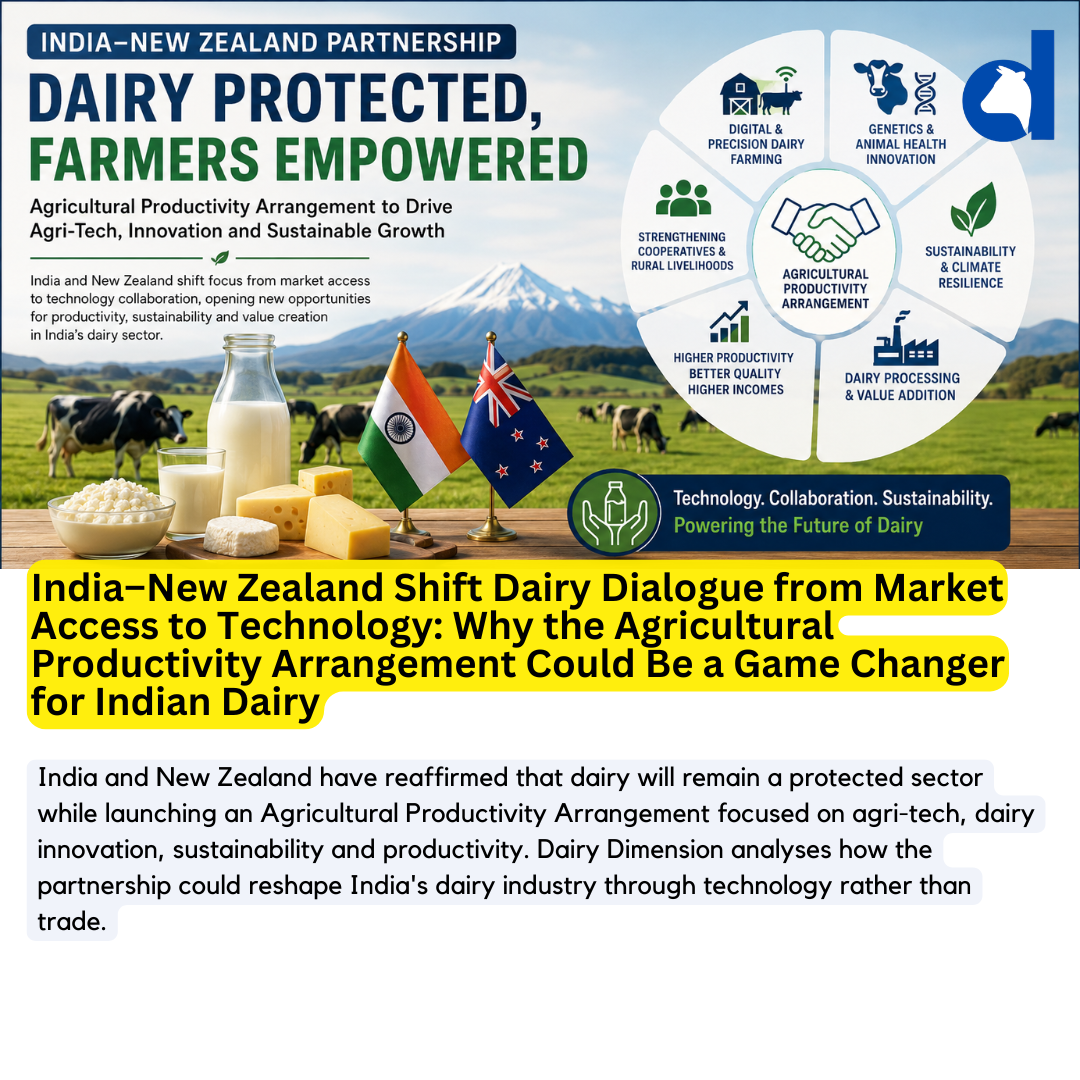
Yet, the visit also marked a significant shift in the narrative. Rather than focusing on tariff reductions or market access, both countries announced an Agricultural Productivity Arrangement, signalling a move towards technology-led collaboration. While the headline may not have attracted the same attention as an FTA announcement, this agreement could ultimately deliver greater long-term value to India’s dairy industry than limited import liberalisation ever would.
A New Direction: Technology Instead of Tariff Negotiations
The announcement reflects a pragmatic understanding by both governments. India is unlikely to compromise on dairy imports, given the sector’s socio-economic importance, while New Zealand possesses globally recognised expertise in agricultural productivity, dairy technology and sustainable farming systems.
The Agricultural Productivity Arrangement therefore creates an opportunity to collaborate in areas where both countries have complementary strengths.
For India, this is less about importing dairy products and more about importing knowledge, innovation and technologies that can strengthen its domestic dairy ecosystem.
Industry Perspective
Reflecting on the long-term significance of the agreement, Prashant Tripathi, Founder of Jordbrukare India, believes the partnership has the potential to redefine dairy collaboration between the two nations beyond conventional trade negotiations.
“Over the next decade, India and New Zealand have the potential to build one of the world’s most important dairy innovation partnerships. New Zealand contributes world-class science, technology and commercial expertise, while India offers unparalleled scale, entrepreneurial capacity and one of the fastest-growing dairy markets globally. Together, they can co-create technologies that are relevant not only for India, but for dairy systems across Asia and the Global South.”
— Prashant Tripathi, Founder, Jordbrukare India
This vision aligns closely with India’s ambition to transform its dairy sector through innovation, sustainability and higher value creation, while maintaining the cooperative model that underpins rural livelihoods. Rather than focusing solely on market access, the partnership opens the door to joint research, technology commercialisation, digital agriculture, climate-smart dairy farming and next-generation processing solutions that could position both countries as leaders in dairy innovation across the Indo-Pacific region.
This collaborative approach has the potential to deliver benefits that extend far beyond bilateral trade, creating scalable solutions for emerging dairy economies while supporting India’s journey towards a Viksit Bharat by 2047.
Improving Productivity Without Expanding Herd Size
India has become the world’s largest milk producer, with annual production exceeding 239 million tonnes. However, productivity per animal remains significantly below that of developed dairy nations.
The challenge is no longer increasing cattle numbers but improving efficiency.
New Zealand has built one of the world’s most productive dairy industries through scientific farm management, precision livestock monitoring, genetics and data-driven decision-making. Access to these technologies could enable Indian farmers to increase milk yields while reducing production costs.
Advanced solutions such as wearable animal sensors, automated heat detection, precision feeding systems, digital herd management platforms and AI-based health monitoring have the potential to improve reproductive performance, reduce disease incidence and optimise farm operations.
For India’s millions of smallholders, even modest improvements in productivity could translate into substantial increases in household income.
Strengthening Farmer Income Through Better Efficiency
Milk remains one of the few agricultural commodities that generates daily or weekly cash flow for rural households. Unlike seasonal crops, dairy provides regular liquidity, making it a critical source of financial stability for millions of families.
Technology adoption offers an opportunity to enhance profitability without requiring additional land or larger herds.
Better feed management can reduce input costs, while early disease detection lowers veterinary expenses. Improved reproductive efficiency shortens calving intervals and increases lifetime productivity. Digital advisory platforms can also support farmers in making better management decisions based on real-time data.
Such productivity gains directly contribute to higher farm incomes while preserving India’s existing cooperative dairy structure.
Modernising India’s Dairy Cooperatives
India’s dairy success has largely been built through cooperative institutions such as Amul, Nandini, Verka, Saras, Milma and numerous state milk federations. However, these organisations are increasingly embracing digital transformation.
Collaboration with New Zealand could accelerate the modernisation of procurement systems through technologies such as automated milk collection, digital quality testing, cloud-based procurement platforms, AI-enabled demand forecasting and integrated farmer payment systems.
These innovations would not only improve operational efficiency but also enhance transparency across the milk supply chain.
Advancing Milk Quality and Food Safety
Quality assurance is rapidly becoming one of the defining priorities for India’s organised dairy sector. As consumer awareness increases and exports expand, processors are investing heavily in traceability, testing and quality-linked procurement.
New Zealand’s experience in farm-level quality assurance, digital traceability and milk monitoring systems could support India’s efforts to strengthen food safety while improving consumer confidence.
Technology-driven quality management also creates opportunities for differential farmer payments based on milk composition and hygiene standards, encouraging continuous quality improvement throughout the value chain.
Accelerating Sustainability and Climate Resilience
Sustainability has become a central theme in global dairy development.
New Zealand has invested extensively in reducing methane emissions, improving nutrient management, conserving water resources and developing climate-smart dairy systems.
Although India’s production systems differ significantly, collaboration in areas such as methane mitigation, renewable energy integration, manure management, water-use efficiency and carbon accounting could strengthen the environmental performance of Indian dairy farming.
These initiatives are becoming increasingly important as international markets, investors and consumers place greater emphasis on sustainable food production.
Building a Future-Ready Dairy Industry
Beyond farm productivity, the Agricultural Productivity Arrangement also opens avenues for collaboration in dairy processing, automation and value-added manufacturing.
India’s dairy industry is witnessing rapid growth in cheese, yoghurt, whey proteins, infant nutrition ingredients and functional dairy products. New Zealand’s expertise in dairy processing technologies, ingredient manufacturing and export-oriented production systems could help Indian processors improve efficiency while expanding their product portfolios.
Joint research programmes involving universities, dairy research institutions, technology companies and start-ups could further accelerate innovation tailored to Indian production conditions.
Commercial Opportunities Beyond Milk Trade
The significance of this partnership extends well beyond farmers and processors.
Indian companies working in dairy automation, milk testing, livestock health, feed technology, farm software, renewable energy, precision agriculture and agri-tech stand to benefit from greater collaboration with New Zealand’s innovation ecosystem.
Similarly, New Zealand companies gain access to one of the world’s fastest-growing agricultural technology markets without requiring politically sensitive dairy import liberalisation.
This creates opportunities for joint ventures, technology licensing, research partnerships, local manufacturing and commercial investment across the dairy value chain.
Why This Matters More Than Dairy Imports
The latest announcements suggest that both governments have recognised an important reality: long-term collaboration does not necessarily require market access.
Instead of debating tariff reductions on dairy products, India and New Zealand are focusing on areas that generate mutual value while respecting each country’s domestic priorities.
For India, protecting the livelihoods of millions of dairy farmers remains non-negotiable. At the same time, achieving the Government’s Viksit Bharat 2047 vision will require significant improvements in agricultural productivity, digitalisation, sustainability and value addition.
The Agricultural Productivity Arrangement provides a framework to pursue these objectives without compromising the cooperative dairy model that has underpinned India’s dairy success for decades.
Dairy Dimension Analysis
The India–New Zealand Agricultural Productivity Arrangement represents a strategic evolution in bilateral cooperation. Rather than allowing dairy market access to remain a recurring point of contention, both countries have chosen to build a partnership around innovation, productivity and sustainable agricultural development.
For India’s dairy sector, the greatest opportunity lies not in importing milk, but in importing technologies, management practices and scientific expertise that can improve productivity, strengthen milk quality, reduce environmental impact and enhance farmer profitability.
If effectively implemented, this partnership has the potential to reshape India’s dairy industry—from one driven primarily by production volume to one characterised by higher productivity, greater efficiency, stronger sustainability and increased value creation. In doing so, it could become one of the most consequential outcomes of the renewed India–New Zealand economic relationship, even if dairy trade itself remains firmly protected.