India’s dairy companies are expected to face mounting profitability pressure in the first half of CY26, as escalating milk procurement prices outpace the industry’s ability to pass on costs to consumers. According to ICICI Securities, the sharp increase in input costs is set to weigh heavily on margins across the Indian dairy industry.
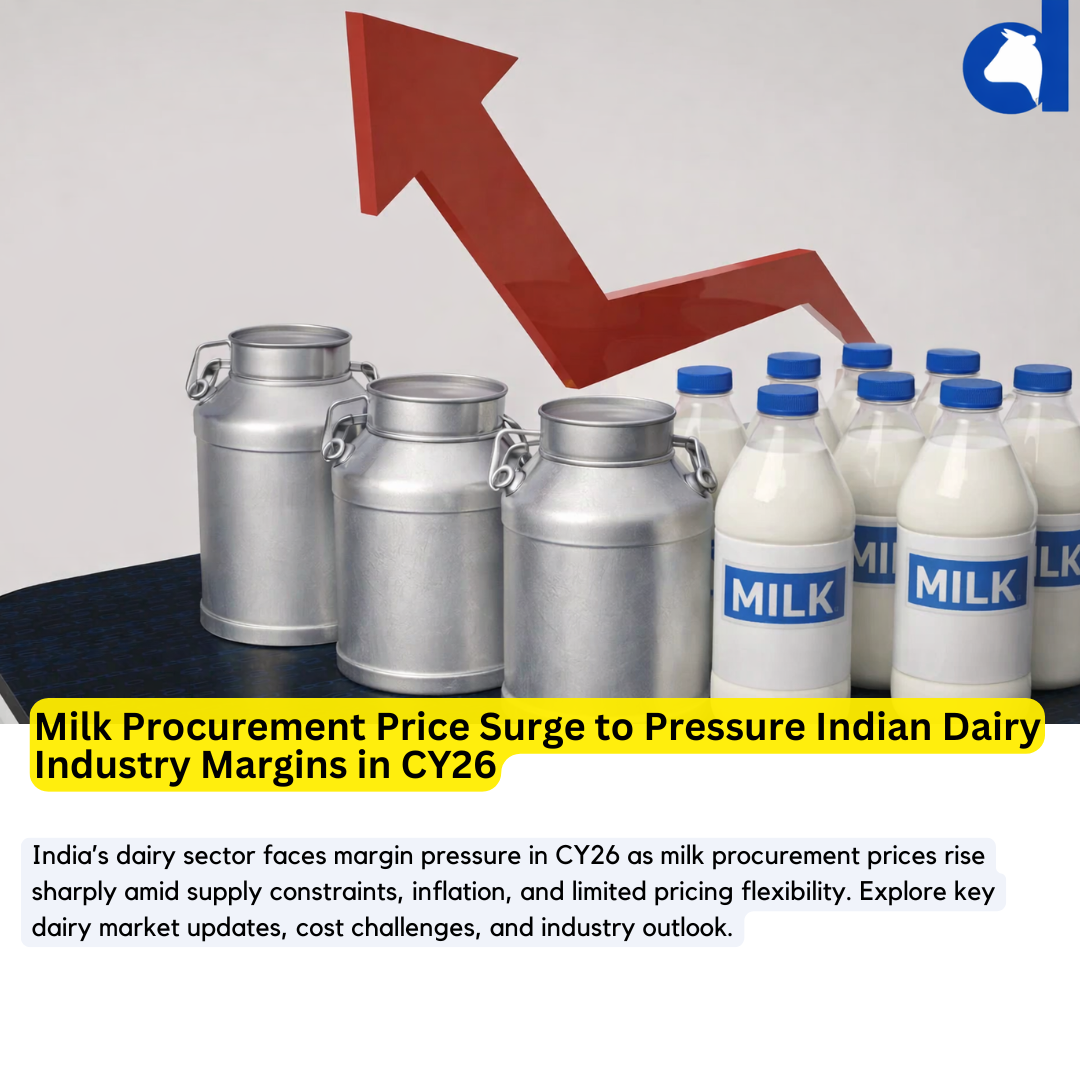
Milk procurement prices, which had already been trending upward during the first nine months of FY26, surged significantly in the March quarter, rising by ₹3–4 per litre. This steep escalation is likely to challenge dairy sector players in India, especially as pricing flexibility remains limited in the near term.
Aniruddha Joshi, Analyst – FMCG at ICICI Securities, highlighted that the increase has been sharper than anticipated, warning that margins could come under considerable stress unless companies implement calibrated price hikes.
Supply Constraints Tighten the Dairy Market
Multiple supply-side challenges are contributing to the current price surge. A weaker-than-expected flush season in FY26 has restricted milk availability, while increased butter exports and declining domestic inventories of butter and skimmed milk powder have further tightened supply buffers.
Lower stock levels of these key dairy commodities have reduced the industry’s ability to absorb rising procurement costs, intensifying the pressure on dairy production news and overall dairy market updates.
Additionally, expectations of a strong summer in CY26 are likely to boost demand for milk and value-added dairy products such as ice cream and buttermilk. This seasonal demand surge may further strain milk supply, creating a challenging environment for balancing supply and pricing.
Limited Pricing Power Amid Policy Sensitivities
Despite rising input costs, dairy companies may find it difficult to increase retail prices immediately. Upcoming state elections in April–May 2026 are expected to limit pricing decisions by both cooperatives and private dairy players, reflecting broader dairy policy considerations in India.
This restriction on price hikes comes at a time when the cost base is expanding, making it harder for companies to protect margins without impacting demand.
External Cost Pressures Add to the Burden
Global factors are also influencing the cost structure of the milk industry news landscape. The ongoing Middle East crisis has driven crude oil prices up by 50–70% year-on-year, pushing them well above the earlier benchmark of $75–80 per barrel.
As a result, packaging materials such as PET and HDPE, along with freight costs, have witnessed inflation of 5–10%. These inputs account for 8–12% of total costs for most FMCG and dairy companies, making absorption difficult without price revisions.
Operational Adjustments and Technology Adoption
To manage these pressures, dairy companies are increasingly focusing on operational efficiencies. Firms are leveraging dairy technology solutions in India to improve supply chain visibility, optimise procurement, and enhance distribution efficiency.
Industry leaders indicate that companies are adjusting cost structures, particularly in fuel-linked operations such as milk collection and cold chain logistics. Strengthening planning systems and adopting precision dairy farming tools are emerging as key strategies to navigate volatility.
Seasonal Demand Offers Partial Relief
Amid the cost pressures, there is some positive momentum in demand. Summer-driven categories, including ice cream and flavoured dairy beverages, are expected to perform strongly, supporting volume growth.
New-age brands are already seeing traction, particularly on quick-commerce platforms, indicating evolving consumer behaviour and rising demand for convenience-driven dairy products.
However, while this demand growth provides some cushion, it may not fully offset margin pressures from rising milk procurement prices and input costs.
Outlook: A Delicate Balancing Act
The near-term outlook for the Indian dairy industry suggests a complex balancing act. Companies must navigate rising input costs, constrained pricing power, and steady consumer demand while maintaining profitability.
Unless milk prices 2025 trends stabilise or companies implement price increases of ₹4–5 per litre, margins are likely to remain under pressure through CY26. The sector’s ability to adapt through innovation, cost management, and strategic pricing will be critical in shaping its performance in the months ahead.