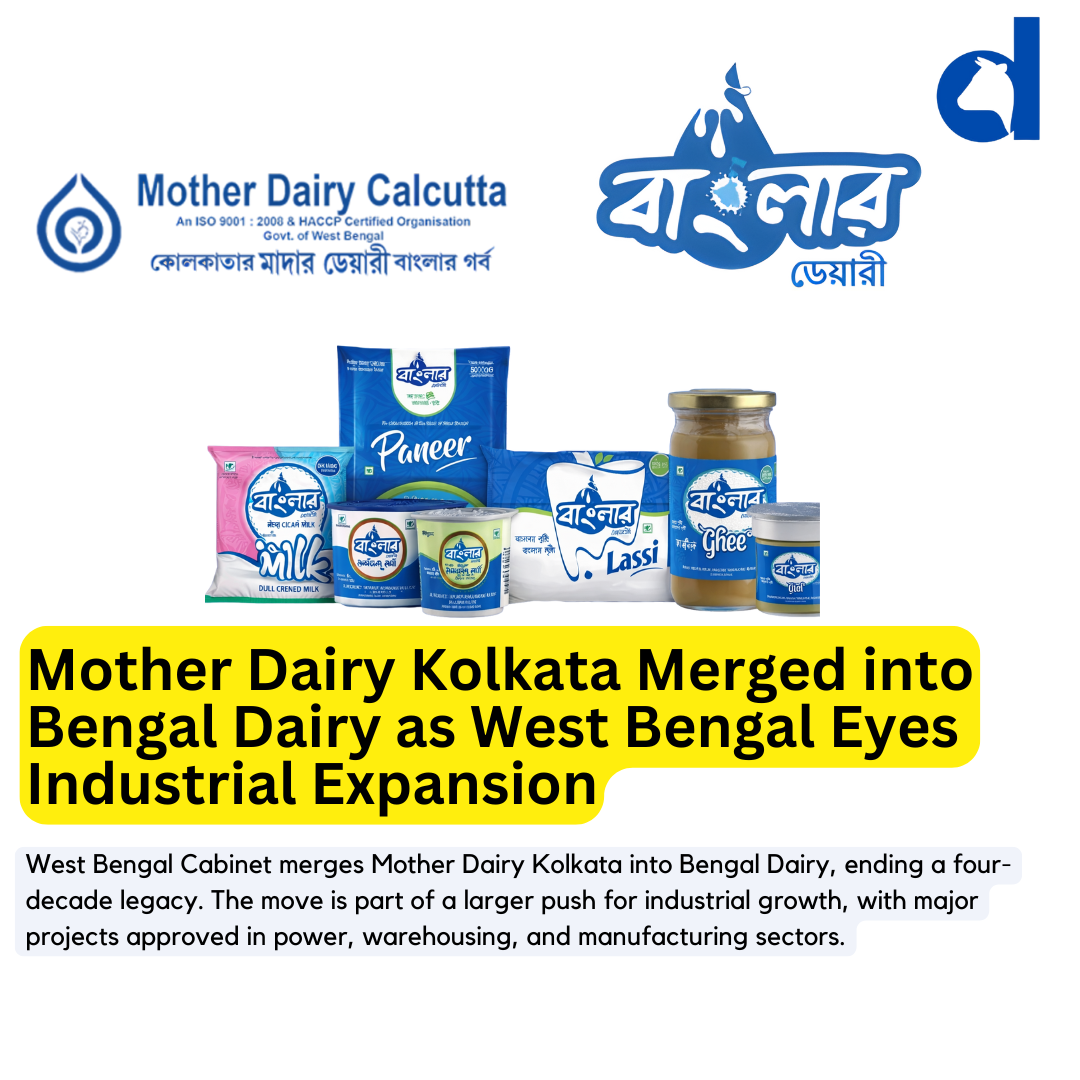
In a significant shift for West Bengal’s dairy landscape, the state Cabinet has approved the merger of Mother Dairy Kolkata with Banglar Dairy, marking the end of one of the region’s most recognisable dairy brands. The move aims to consolidate operations, strengthen cooperative frameworks, and align with the state’s broader industrial development strategy.
The decision was announced on 24 December 2025 by senior Cabinet member Chandrima Bhattacharya, confirming that all milk and dairy products currently sold under the Mother Dairy Kolkata label will henceforth carry the Banglar Dairy name.
“This transition will unify branding and support a more efficient cooperative model for the state’s dairy sector,” said Chandrima Bhattacharya.
From Legacy to Consolidation
Founded in 1978, Mother Dairy Kolkata was established by the West Bengal government to ensure an accessible, hygienic milk supply across the state. Although it shared its name with the NDDB’s Mother Dairy in Delhi, Kolkata’s brand operated under a separate cooperative structure — the West Bengal Cooperative Milk Producers’ Federation Ltd (WBCMPFL).
Over four decades, the brand has built strong consumer loyalty in Kolkata and the surrounding districts. The merger with Banglar Dairy reflects a strategic shift to unify the state’s dairy operations and enhance value-chain integration for both rural producers and urban consumers.
A Legacy of Cooperative Success: A Brief History of Mother Dairy Calcutta
Mother Dairy Calcutta, a Government of West Bengal initiative, was launched under Operation Flood II by the National Dairy Development Board (NDDB) to supply the Kolkata Metropolitan Area (approx. 852 sq km) with safe and hygienic milk. Commissioned in July 1978, it began distributing its first milk sachets on 8 December 1978.
Initially managed by NDDB, the dairy was officially dedicated to the people of West Bengal on 24 March 1982 by then Chief Minister Shri Jyoti Basu. Since then, it has become a powerful example of cooperative-driven rural development. Marketing surplus milk from rural producers helped expand rural wealth and boost the cooperative movement, inspired by the vision of Dr Verghese Kurien.
The dairy expanded its reach beyond Kolkata and diversified into products such as mishti doi, flavoured yoghurt, paneer, cow ghee, and packaged drinking water. Under Operation Flood III, its capacity was upgraded to 600,000 litres per day by 1997. It also earned several quality certifications, including ISO 9002, ISO 9001:2000, ISO 9001:2008, and environmental awards, highlighting its commitment to excellence.
Implications for the Dairy Sector
The brand consolidation is expected to streamline logistics, improve procurement efficiency, and boost rural dairy income through better-managed cooperative networks. While it marks the end of a legacy brand, it may also open doors for Bengal Dairy to expand into value-added dairy products, adopt clean milk production practices, and align with eco-friendly dairy goals.
As West Bengal ramps up its industrial development, this dairy sector reform positions Banglar Dairy to play a pivotal role in supporting both nutritional security and rural livelihoods.