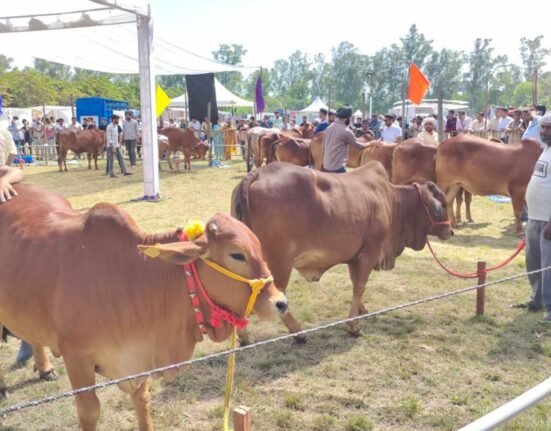
A specialised dairy farm in Mandaguari, Paraná, Brazil, is aiming to increase its daily milk production from approximately 3,000 litres to 5,000 litres through improved herd management, mechanical milking, balanced nutrition and continuous animal care. The operation highlights the importance of consistent farm routines, investment in equipment and effective livestock management in strengthening dairy productivity.
Managed by Antônio Furnanetto, 56, with the support of Ronaldo Chavioli, 43, the farm represents part of Mandaguari’s remaining specialised dairy sector. The operation combines confined and semi-confined cattle management with on-farm feed production, refrigerated milk storage and regular collection by a dairy processor.
From Mandaguari’s Dairy Heritage to Modern Milk Production
Mandaguari historically maintained a substantial dairy industry, with much of its locally produced milk collected and processed by the former Mandaguari Dairy Cooperative, known as Colari. However, the sector subsequently declined as larger producers moved away and the cooperative relocated its operations to Londrina.
Today, specialised dairy farms continue to contribute to the region’s agricultural economy. Furnanetto has managed the property for approximately ten years, while Chavioli has lived and worked there for five years, handling daily farm activities and coordinating feeding operations.
The farm currently produces around 3,000 litres of milk daily, with an expansion target of 5,000 litres. Achieving this goal will require careful management of herd productivity, nutrition, animal comfort and operational capacity.
Mechanical Milking and Refrigerated Storage Support Milk Quality
The farm operates mechanical milking systems twice daily, with approximately 12 hours between sessions. Milk passes through stainless-steel equipment directly into a refrigerated storage tank, reducing manual handling and helping maintain appropriate storage conditions before collection.
Volpato dairy, based in Arapongas, collects the farm’s milk every two days for further processing.
The producers are also considering introducing a third daily milking session, which would reduce the interval between milkings to approximately eight hours. Any such change would need to be evaluated against milk yield, labour availability, animal welfare, equipment capacity and operating costs.
Reliable cooling and hygienic handling remain essential to maintaining milk quality throughout collection and transportation. As production increases, adequate refrigeration and collection arrangements will become increasingly important for the farm’s operations.
Holstein Cattle and Future Herd Diversification
The herd consists mainly of Holstein cattle, a breed widely used in commercial dairy production because of its high milk-producing potential. The farm uses confined and semi-confined systems to manage its animals and feeding routines.
The producers are also considering adding Jersey cattle. Although Jersey cows generally produce less milk by volume than Holsteins, their milk often contains higher concentrations of milk fat and protein, making it valuable for certain dairy processing applications.
Introducing another breed could allow the farm to diversify its production strategy. However, the benefits would depend on breeding decisions, feeding costs, milk pricing arrangements and the requirements of its dairy processor.
Balanced Nutrition and Silage Production
Feed management is central to the farm’s production strategy. With guidance from an animal nutrition professional, the cows receive maize silage, concentrated feed, haylage and hay. Much of this feed is produced on the property, helping the farm maintain a supply of essential nutritional inputs.
Maize grown for livestock feed is harvested at an appropriate stage, chopped and stored in silos. Proper silage preparation and storage help preserve feed quality and provide a dependable source of nutrition throughout the year.
A balanced ration supports rumen function, milk production and overall animal health. Consistent feed availability becomes especially important when farms operate throughout changing seasons or face fluctuations in the cost of purchased feed.
Climate, Labour and Continuous Animal Care
Weather conditions also influence dairy productivity. The producers report that extreme heat, cold and irregular rainfall can affect animal comfort and milk output. Maintaining suitable housing, access to water, feed availability and appropriate ventilation can help reduce some of these challenges.
The farm depends on a small team that includes workers responsible for milking, relatives who assist with calf care and cleaning, and Chavioli, who coordinates feeding. Additional day labourers are hired when required.
Daily responsibilities continue throughout the week, covering feeding, milking, cleaning, animal monitoring and equipment management. Although mechanisation has reduced some physical work, dairy production still requires consistent attention and planning.
Outlook for Dairy Production
The Mandaguari farm illustrates how mechanical milking, refrigeration, on-farm feed production and herd management can support a dairy business seeking to expand its output.
Increasing production to 5,000 litres per day will depend on the farm’s ability to maintain animal health, manage feed costs, ensure milk quality and secure sufficient labour and infrastructure. The possible introduction of a third milking session and Jersey cattle also presents decisions that require careful operational and financial evaluation.
The experience reinforces a central principle of dairy farming: sustainable growth depends not only on producing more milk, but also on maintaining consistent routines, protecting animal welfare and managing resources efficiently. For Brazil’s dairy sector, these fundamentals remain important to the long-term viability of specialised milk-producing farms.