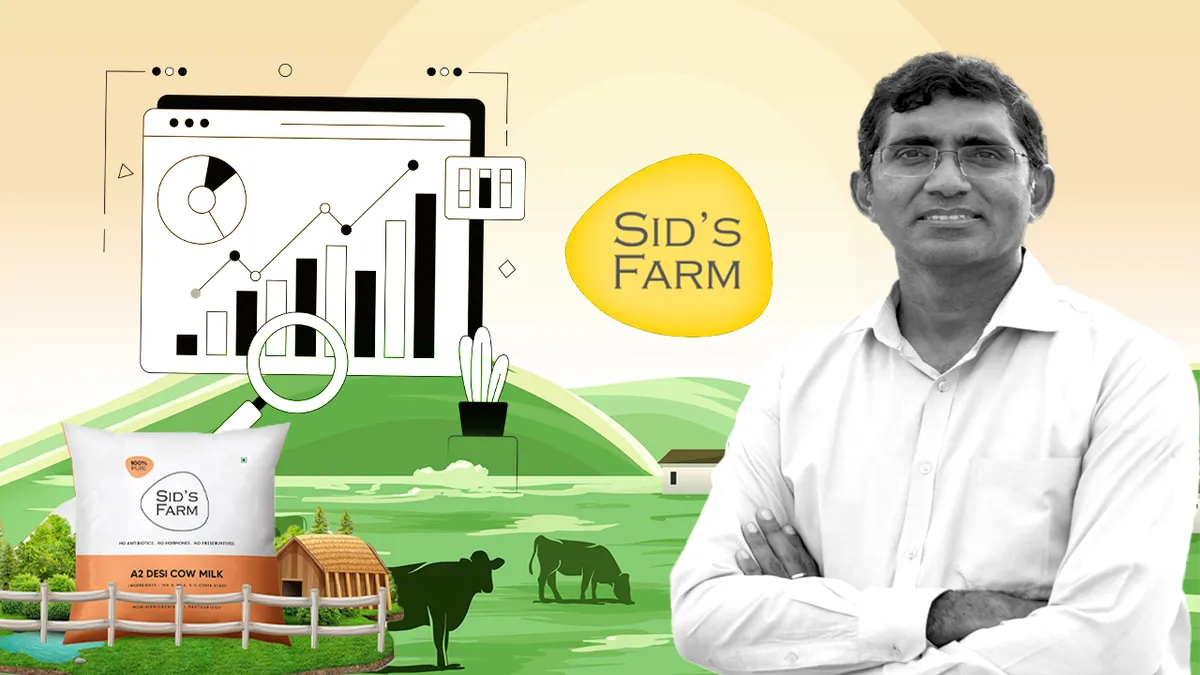
Growth is Visible. Profitability Is Elusive.
Sid’s Farm’s FY25 performance offers a revealing case study on the structural challenges of building a fresh-food brand at scale in India. While demand for clean, traceable dairy continues to rise, the economics of delivering freshness profitably remain stubbornly complex.
Founded in 2016, Hyderabad-based Sid’s Farm was built to address long-standing inefficiencies in India’s dairy value chain. By eliminating middlemen, sourcing directly from farmers, and retaining control over processing and last-mile delivery, the company positioned itself as a vertically integrated, trust-first dairy brand for urban consumers.
The market responded positively.
In FY25, Sid’s Farm reported a 38% increase in operating revenue, growing from ₹122 crore to ₹168 crore. Including other income, total revenue reached approximately ₹170 crore. On the surface, this is the kind of growth trajectory most consumer brands aspire to. However, the financials also underscore a more sobering reality: scale amplified costs faster than revenues.
When Growth Multiplies Costs
Total expenses rose 47% year-on-year to ₹196 crore, significantly outpacing topline growth. As a result, losses widened sharply, increasing 2.6 times to ₹27 crore, compared to ₹10.5 crore in the previous year. Put simply, for every ₹1 earned, Sid’s Farm spent ₹1.17.
A closer look at the cost structure explains why scaling fresh dairy remains particularly capital-intensive:
Raw milk and material costs accounted for over 64% of total expenses, amounting to ₹126 crore. Unlike packaged FMCG, dairy offers limited flexibility on input costs, especially when farmer payouts and quality controls are non-negotiable.
Employee expenses rose 47% to ₹25 crore, reflecting the manpower required for procurement, quality assurance, processing, and distribution.
Advertising and brand-building spend nearly doubled to ₹7 crore, highlighting the cost of acquiring and retaining trust in a crowded urban dairy market.
Distribution and logistics crossed ₹13 crore, a reminder that cold-chain delivery and daily fulfilment significantly strain margins.
The Fresh-Food Paradox
Sid’s Farm’s experience highlights a core paradox faced by fresh-food startups in India: demand is strong, but margins are fragile.
Unlike asset-light digital businesses, fresh dairy companies operate with high fixed and variable costs—farms, chilling centres, processing units, logistics fleets, and stringent quality controls. Each layer adds resilience and trust, but also compresses margins.
While scale can improve operational efficiencies over time, it does not automatically translate into profitability. In fact, premature or aggressive expansion can deepen losses before unit economics stabilise.
Investor Patience, Strategic Focus
Despite widening losses, investor confidence has remained intact. Sid’s Farm has raised $12.2 million to date, including a $10 million round led by Omnivore and the Narotam Sekhsaria Family Office. This continued backing suggests belief in the long-term value of a trusted, vertically integrated dairy platform, even if short-term profitability remains elusive.
For investors and industry observers alike, the bet is not merely on growth, but on whether operational discipline, pricing power, and supply-chain optimisation can eventually rebalance the economics.
A Broader Industry Lesson
Sid’s Farm’s journey is emblematic of the broader Indian dairy and fresh-food ecosystem. Building consumer trust at scale is not just a branding challenge; it is an operational one. The real test lies in mastering unit economics without compromising farmer welfare or product integrity.
As the sector matures, success will likely favour companies that prioritise depth over speed, efficiency over expansion headlines, and sustainable margins over vanity growth. In fresh dairy, scale alone is not the destination. Sustainable economics are.