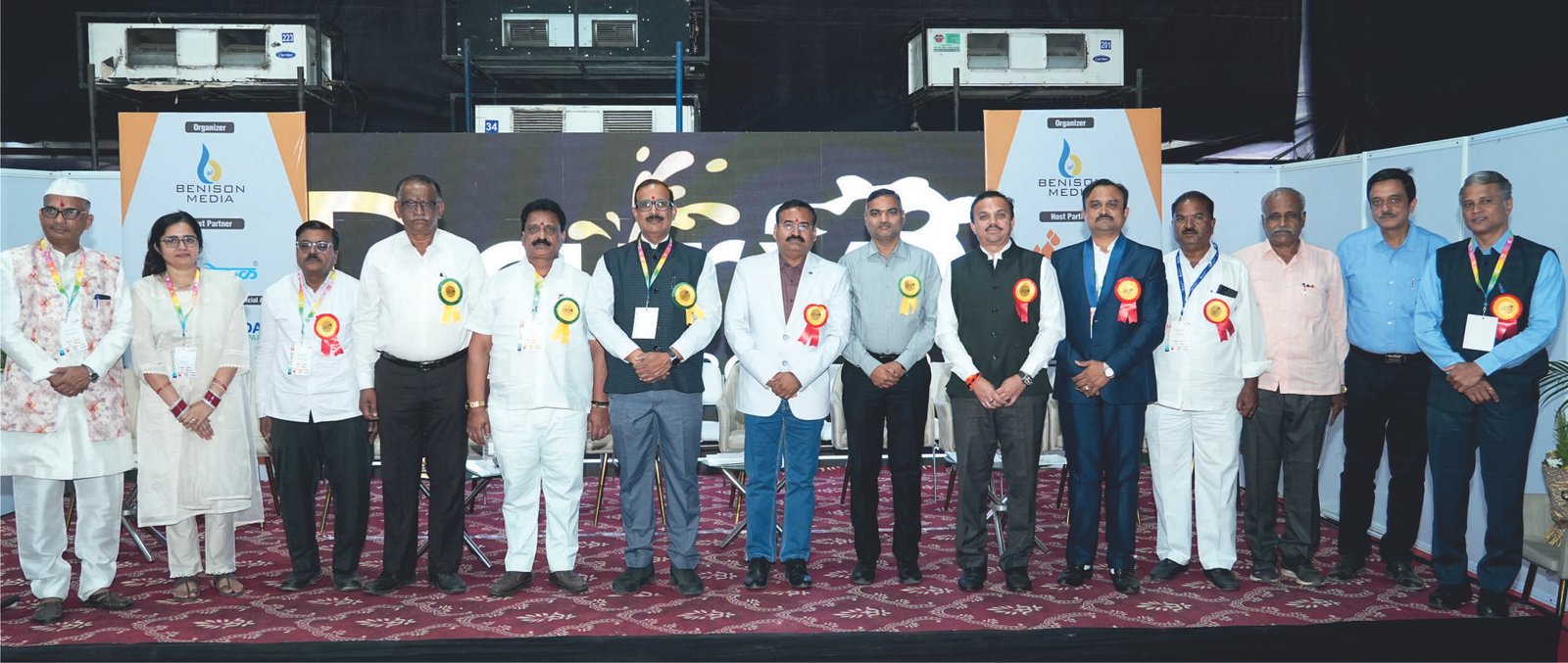
The 10th edition of Dairy Industry Expo, Kolhapur, brought together dairy industry leaders, policymakers, researchers and technology experts to discuss the challenges and opportunities shaping India’s dairy sector. The expo was inaugurated in the presence of Mr Girish D. Chitale of B. G. Chitale Dairy, who graced the occasion as the Chief Guest. The Guests of Honour included Shri Pradeep Malgave, Assistant Registrar of Cooperative Societies (Dairy), Kolhapur; Shri Sangram Nanasaheb Fadtare, Chairman, Krushna Dudh; Shri Shashikant Patil, Vice-Chairman, Krushna Dudh; Dr N. M. Markandey, Animal Genetics Expert; Dr A. V. Harikumar, NDDB; Dr Yogesh Godbole, Managing Director, Gokul; Dr Sachin Dhope, Managing Director, Krushna Dudh; and other dairy industry dignitaries.
The knowledge programme featured eminent experts from the dairy, animal nutrition, breeding, veterinary and research sectors, including Dr Inderjeet Singh, Bihar Animal Sciences University; Dr N. M. Markandey, Animal Genetics Expert; Dr A. V. Harikumar, NDDB; Dr Sachin Joshi, BAIF; Dr Thanammal S. Raju, Kumaraguru Institutions; Dr Someshwar Zadbuke, Godrej Agrovet; Dr Dayavardhan Kamat, Gokul; Dr V. D. Patil, Gokul; Dr S. Gaikwad, Govind Milk; Dr Shailesh Madane, Advanced Enzymes; and other specialists.
The inaugural discussions highlighted the distinctive economic structure of India’s dairy sector, particularly in Western Maharashtra, where more than 65% of the consumer price of pasteurised milk goes back to farmers as raw milk procurement payments. The dairy leaders emphasised the importance of bringing farmers and the processing industry onto a common platform like Dairy Industry Expo to understand the value chain and address the economic challenges faced by dairy organisations.
They called for a shift towards technology-driven and business-oriented dairy farming, with greater emphasis on productivity, scientific breeding, balanced nutrition, efficient resource utilisation and farmer entrepreneurship. The discussions also highlighted the need to strengthen indigenous buffalo breeds, particularly Pandharpuri, whose milk yield has reportedly declined from around six litres to three litres. Fodder and water management, adoption of wearable animal-monitoring devices and improved farm practices were identified as important areas for future growth.
Key presentations and outcomes
- Improving Dairy Farm Profitability Through Reproductive Management and Animal Comfort
Prof. Dr Niteen M. Markandey emphasised that reproductive efficiency is central to dairy farm profitability. He outlined six key expectations from every milch animal: normal calving, timely expulsion of the placenta, no post-calving complications, steadily increasing milk yield, return to heat within 60 days in cows and 90 days in buffaloes, and successful conception by the third month in cows and fourth month in buffaloes.
He stressed the importance of maintaining reproductive records, particularly heat dates, as the oestrus cycle generally repeats every 21 days. He also recommended monitoring body growth through simple chest measurements using a tailor’s tape. Highlighting affordable management practices, he advocated dry flooring, a simple roof and adequate space instead of expensive housing structures. He noted that in a comfortable shed, around 70% of animals should be resting and chewing cud, underlining the role of animal comfort in reproductive performance and productivity.
- One Healthy Calf Every Year: Improving Dairy Profitability Through Reproductive Management
Dr Dayavardhan Kamat of Gokul highlighted that reproductive efficiency is one of the most cost-effective ways to improve milk production and farmer income. He emphasised the importance of reducing the calving interval, particularly in Pandharpuri buffaloes, which have an average interval of around 465 days. Reducing this to 400 days could save farmers approximately INR 9,750 per animal annually. He identified missed heat detection, poor nutrition, mineral deficiencies and incorrect insemination timing as major causes of reproductive inefficiency. He advocated twice-daily heat observation, timely artificial insemination, balanced feeding, mineral supplementation and proper post-calving care. He also stressed heat-stress management, quality semen, trained AI services and systematic reproductive records to reduce unproductive days and improve herd profitability.
- Strengthening Livestock Healthcare Through Traditional Knowledge and Scientific Validation
Dr A. V. Harikumar of NDDB, Anand, highlighted the potential of India’s traditional veterinary knowledge in addressing antimicrobial resistance (AMR), reducing treatment costs and improving livestock health. He presented NDDB’s Ethno-Veterinary Medicine (EVM) programme, which has expanded since 2017-18 to cover over 1,500 dairy co-operative societies across 12 milk unions and producer companies in eight states.
The programme has recorded nearly 13.7 lakh treatment cases, with an overall cure rate of 81%. Specific outcomes included 77.8% successful conception among repeat-breeder animals and 85% negative results in sub-clinical mastitis testing after two courses of treatment. In one milk union, antibiotic consumption declined by 65%, while antibiotic costs per veterinary visit fell by 63%.
He also highlighted the economic benefits, with mastitis treatment costs declining from approximately INR 3,000 to INR 120 per animal. Emphasising scientific validation, he explained how NDDB has evaluated EVM formulations through research institutions. He noted that EVM has also been incorporated into the Government of India’s Standard Veterinary Treatment Guidelines for Livestock and Poultry.
- Turning Dairy Sector Challenges into Rural Entrepreneurship Opportunities
Dr Thanammal S. Raju of Kumaraguru Institutions highlighted how challenges such as high feed costs, fodder shortages, low animal productivity and limited veterinary access can create opportunities for rural entrepreneurship. She presented two business models: fodder and feed enterprises promoting silage, hay, TMR and fodder seed production; and Rural Dairy Marts offering feed, mineral mixtures, veterinary essentials, breeding linkages, equipment rental and farmer advisory services.
Drawing on examples from Tamil Nadu, she demonstrated how village-level service centres can generate revenue through diversified products, repeat customers and farmer trust. She particularly emphasised opportunities for women through SHGs and FPOs and for rural youth through silage production, fodder enterprises and custom-hiring services. She also highlighted the National Livestock Mission’s 50% capital subsidy, up to INR 50 lakh, for eligible fodder-related enterprises.
- Buffalo-Led White Revolution 2.0: Reclaiming India’s Global Leadership
Dr Inderjeet Singh, Murrah Man of India, highlighted the potential of buffaloes as an efficient, climate-resilient and economically valuable dairy animal. Despite having the world’s largest buffalo population and several globally recognised breeds, India’s buffalo milk contribution declined from historical over 50% to 43.15% in 2024-25, compared with 53.62% for cow milk. He contrasted India’s position with Pakistan and China, which are investing in genetic improvement, embryo transfer, artificial insemination and organised buffalo dairying.
He recommended developing elite breeding herds, strengthening AI and embryo-transfer services, maintaining breed registries and performance records, and linking incentives to measurable breeding outcomes. He emphasised that India must build on its indigenous breeds, including Murrah, Nili-Ravi, Banni and Mehsana, to lead the next phase of dairy development.

- Bridging the Dairy Productivity Gap: Lessons from Punjab for Maharashtra
Dr Someshwar Zadbuke d Godrej Agrovet highlighted the importance of balanced nutrition, genetics, animal health and farm management in improving dairy productivity. Comparing Punjab and Maharashtra, he noted that Maharashtra produces 16.6 million tonnes of milk against Punjab’s 14 million tonnes, recording 63.8% growth over the past decade. However, Punjab achieves over 9,000 kg of milk per animal compared with Maharashtra’s 5,000-plus kg, nearly twice the productivity. Punjab achieves this across 41.7 lakh hectares, while Maharashtra has 307 lakh hectares, including approximately 75 lakh hectares in its western milk belt.
He attributed Punjab’s productivity advantage to a higher share of crossbred and exotic animals, balanced rations, assured year-round green fodder, challenge feeding and stronger veterinary and milk procurement networks. He advocated precision feeding according to the animal’s age and lactation stage, adequate energy, protein and mineral supplementation, and better calf and transition-cow management. He also emphasised that farmers should assess feed based on income over feed cost rather than purchase price alone.
- Loose Housing and Cow Comfort: The Foundation of Better Dairy Productivity
Dr S. Gaikwad of Govind Milk highlighted the importance of animal comfort in improving dairy productivity and farm profitability. He advocated loose housing systems that allow cows to move freely, rest and access drinking water according to their needs. Reinforcing the principle of “Happy cow, happy milk”, he recommended practical investments such as rubber mats and grooming brushes, noting that improved comfort and hygiene can support better milk production and justify their cost.
- Improving Dairy Nutrition Through Scientific Feeding and Feed Efficiency
Dr Shailesh Madane of Advanced Enzyme Technologies highlighted the importance of evaluating dairy farm profitability beyond milk production, noting that feed accounts for a major share of milk production costs. He prioritised clean drinking water, followed by quality fodder, concentrate and supplements. Explaining dry matter requirements, he illustrated that a 500 kg cow producing 20 litres of milk requires approximately 16.6 kg of dry matter daily, while 25 kg of green maize supplies only around 6 kg.
He cautioned against late harvesting of maize for silage, which increases fibre content and reduces starch availability, limiting its nutritional value. He stressed that proper fodder harvesting, silage preparation and balanced ration formulation are essential for improving feed efficiency and milk productivity.
- Improving Dairy Profitability Through Balanced Feeding, Fodder Management and TMR
Dr V. D. Patil highlighted that dairy profitability depends on reducing the cost of producing each litre of milk through efficient feed and fodder management. Illustrating this with a cost comparison, he explained that a 2-litre animal incurs a daily feed cost of INR 160 (INR 80 per litre), while a 10-litre animal costs INR 270 per day, bringing the feed cost down to INR 27 per litre.
He advocated a balanced ration comprising green fodder, dry fodder, concentrate, mineral and vitamin mixtures, and additives. His recommended feeding principle was that two-thirds of dry matter should come from roughage and one-third from concentrate. He also highlighted silage as an effective year-round alternative to green fodder and stressed proper harvesting and quality testing.
Addressing fodder shortages and crop residue wastage, he presented Gokul’s approach to converting agricultural residues into Total Mixed Ration (TMR). Combining roughage and concentrate in balanced proportions helps improve feed intake, rumen health, nutrient utilisation and reduce feed wastage. He also outlined Gokul’s cattle feed infrastructure which produces six varieties of cattle feed and three mineral mixtures, with annual sales of approximately 1.4 lakh tonnes and turnover of INR 400 crore.
Concluding perspective
The knowledge programme collectively underlined that the future of Indian dairying will depend on improving productivity at the animal and farm levels while strengthening the supporting ecosystem. Scientific breeding, reproductive efficiency, balanced nutrition, fodder security, preventive healthcare, animal comfort and rural entrepreneurship emerged as interconnected priorities.
The discussions reinforced the need to move from volume-led dairy farming towards productivity- and profitability-driven models, supported by technology, research, farmer education and stronger cooperation between dairy institutions, processors and producers.
Building on the success of the 2026 edition, the next Dairy Industry Expo, Kolhapur, is scheduled for 1–3 October 2027 at Ramkrishna Lawns, Kolhapur.