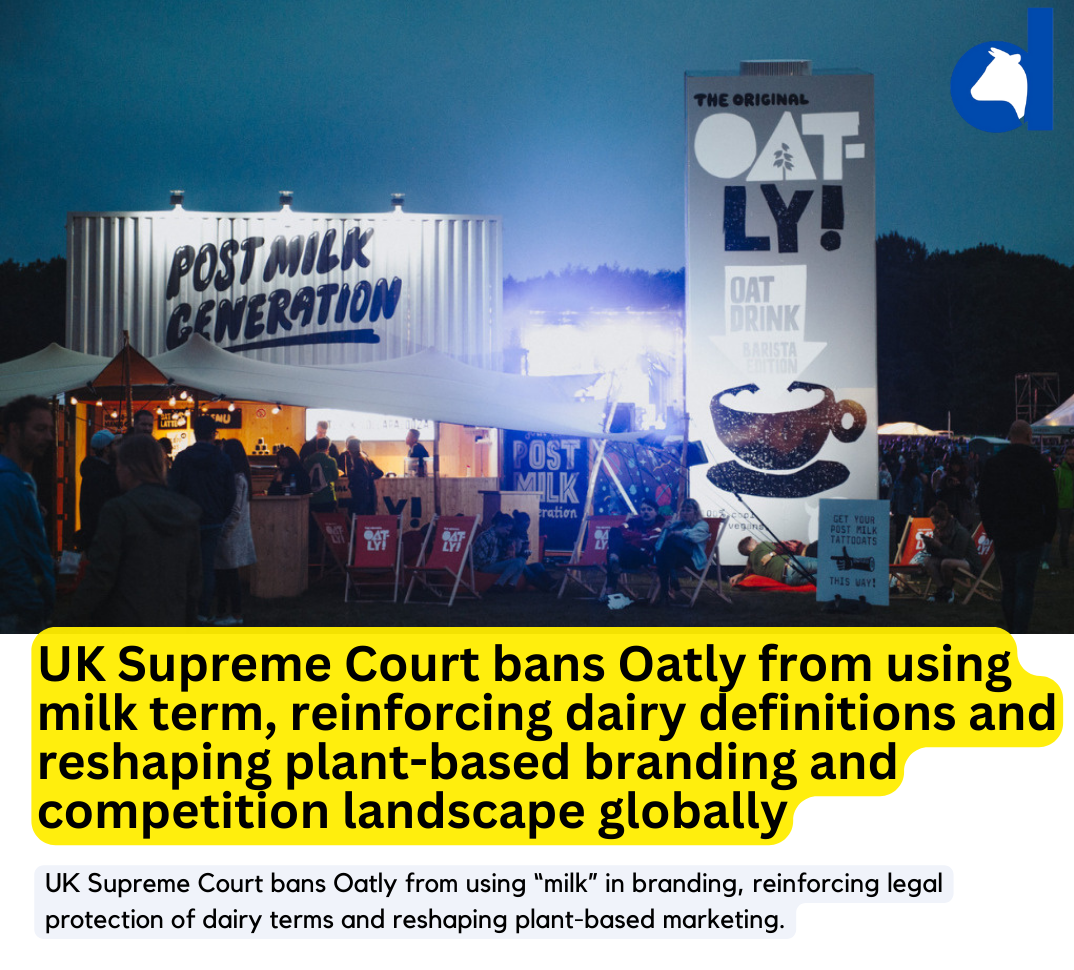
The UK Supreme Court’s ruling against Swedish plant-based drinks company Oatly marks a decisive moment in the long-running debate over the use of dairy terminology in alternative product marketing. By prohibiting Oatly from trademarking and using the slogan “Post Milk Generation”, the court has reinforced a strict interpretation of food labelling regulations that reserve the term milk exclusively for animal-derived products.
The judgment brings legal clarity, but it also sharpens the competitive and regulatory divide between traditional dairy producers and the fast-growing plant-based sector.
Legal Clarity on Dairy Terminology
UK and EU-derived regulations define milk as a product obtained from animals, with similar protections extended to terms such as cream, butter, cheese, and yoghurt. The Supreme Court unanimously upheld this definition, ruling that the use of the word “milk” in Oatly’s trademark could mislead consumers, even if deployed in a non-descriptive or symbolic manner.
The decision overturns earlier rulings that had temporarily favoured Oatly and aligns with objections raised by Dairy UK, the industry’s trade body. The court’s stance signals a firm rejection of what regulators describe as “category borrowing” in regulated food sectors.
Implications for the Dairy Sector
For the dairy industry, the ruling provides long-awaited certainty. It protects legally defined terms that carry nutritional, cultural, and economic significance, particularly for farmers whose livelihoods depend on product differentiation and consumer trust.
Dairy UK welcomed the decision, noting that it preserves the clarity of long-established dairy terms while still allowing plant-based producers to use lawful, descriptive alternatives. From a sectoral perspective, the ruling strengthens the integrity of dairy branding at a time when consumer choices are increasingly shaped by sustainability and health narratives.
Challenges for Plant-Based Producers
Oatly has criticised the ruling as anti-competitive, arguing that it favours “Big Dairy” and limits brand expression. However, legal experts point out that the judgment does not restrict market access for plant-based products. Instead, it requires clearer product naming, such as oat drink or plant-based beverage.
The decision also has wider European implications. Oatly’s trademarks in other jurisdictions may now face challenges from national dairy trade bodies operating under similar regulatory frameworks.
A Signal of Regulatory Direction
Beyond dairy, the ruling reflects a broader regulatory trend. UK courts and regulators appear increasingly willing to enforce strict definitions in protected product categories. Businesses building brands around legally defined food terms should expect closer scrutiny and adapt branding strategies accordingly.
Conclusion
The Supreme Court’s ruling does not curtail innovation in plant-based foods, but it does draw a firm boundary around dairy terminology. For the dairy sector, this represents a significant regulatory affirmation. For alternative producers, it underscores the need to compete on product value rather than borrowed category identity. As dairy and plant-based markets continue to grow in parallel, clarity rather than convergence may now define the regulatory landscape.