From a reluctant engineer in Anand to the architect of India’s White Revolution
Dr. Verghese Kurien’s journey from a young mechanical engineer with little interest in dairy farming to the architect of India’s White Revolution remains one of the most influential stories in the country’s agricultural history.
Born in 1921, Kurien arrived in Anand, Gujarat, in 1949 to complete a government service obligation. What was expected to be a short assignment eventually became a more than five-decade career that transformed India’s dairy industry and established farmer-owned cooperatives as a powerful economic model.
From Anand to a National Dairy Movement
Kurien’s turning point came when he witnessed dairy farmers in Kaira district challenging the dominance of private milk traders. The farmers, supported by cooperative leader Tribhuvandas Patel, were seeking greater control over milk procurement, processing and marketing.
Rather than returning to his original career plans, Kurien chose to support the cooperative movement.
The Kaira District Cooperative Milk Producers’ Union, later associated with the Amul brand, became the foundation for what would eventually be known as the Anand Model.
At its heart was a simple principle: farmers should own and participate directly in the value chain rather than remain dependent on intermediaries.
Building the Amul Model
The cooperative structure developed around three levels:
| Level | Role |
|---|---|
| Village dairy cooperative societies | Milk collection and farmer participation |
| District milk unions | Processing and manufacturing |
| State federation | Marketing and distribution |
This structure enabled farmers to collectively manage milk procurement while benefiting from processing and marketing activities.
Kurien also emphasised technological innovation. Working with dairy technologist H.M. Dalaya, the cooperative developed methods for producing milk powder from buffalo milk. This helped demonstrate that India could develop dairy-processing technologies suited to its own livestock and production conditions.
The model combined farmer ownership, professional management, technology and organised marketing, eventually creating one of the country’s most recognisable dairy brands.
Operation Flood Takes the Model Nationwide
Kurien’s influence expanded beyond Gujarat after Prime Minister Lal Bahadur Shastri visited Anand in 1964.
The National Dairy Development Board (NDDB) was established in 1965, with Kurien as its founding chairman. His leadership later became central to Operation Flood, launched in 1970.
The programme sought to replicate the cooperative model across India while strengthening milk procurement, processing, distribution and farmer access to markets.
India’s milk production subsequently increased dramatically. According to the figures cited in the source material, production rose from approximately 21.2 million tonnes in 1968-69 to more than 55.6 million tonnes by 1991-92.
The transformation helped India move from a milk-deficit country towards becoming the world’s largest milk producer.
A Model Built Around Farmer Ownership
One of Kurien’s most important contributions was changing the relationship between farmers and the dairy industry.
Under the cooperative approach, farmers were not simply raw-material suppliers. They became members and owners of the organisations collecting and processing their milk.
Milk payments were linked to measurable quality parameters such as fat content, creating greater transparency in procurement.
This approach helped establish a model in which rural producers could participate more directly in the economic value generated by dairy processing and marketing.
Challenges Behind the Success
The cooperative movement did not develop without difficulties.
Initially, farmers had to overcome years of distrust towards organised milk procurement systems. Transparent testing, predictable payments and cooperative ownership were important in building confidence.
Kurien also faced institutional and political disagreements during his long career. He stepped down as NDDB chairman in 1998 after more than three decades in the position and later left the chairmanship of the Gujarat Cooperative Milk Marketing Federation (GCMMF) in 2006.
These episodes highlighted another challenge for founder-led institutions: maintaining continuity and effective succession after decades of strong individual leadership.
Key Milestones in Kurien’s Journey
| Year | Development |
|---|---|
| 1949 | Kurien arrived in Anand |
| 1950s | Helped strengthen the Kaira cooperative and Amul |
| 1965 | NDDB established with Kurien as founding chairman |
| 1970 | Operation Flood launched |
| 1973 | GCMMF established to market Amul products |
| 1998 | Kurien stepped down as NDDB chairman |
| 2006 | Kurien left the GCMMF chairmanship |
| 2012 | Verghese Kurien passed away |
Legacy Beyond Dairy
Kurien’s legacy extends beyond the growth of milk production. His work demonstrated how cooperative ownership could be combined with professional management, technology and large-scale marketing.
The Anand Model subsequently became a reference point for dairy development programmes across India and influenced how policymakers approached rural value chains.
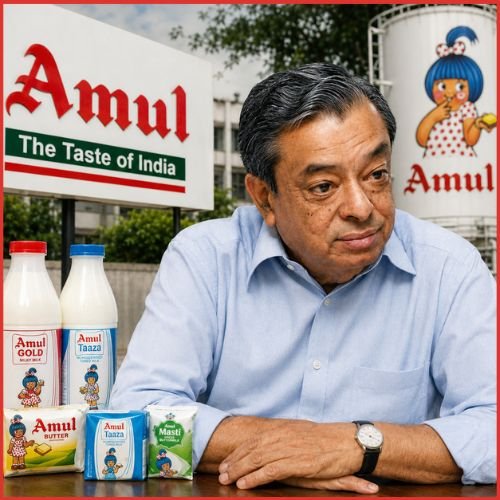
Amul’s continued prominence also demonstrates the long-term potential of the model. Today, GCMMF remains a major force in India’s dairy sector, while the Amul brand has expanded across milk, butter, ghee, cheese, ice cream, beverages and other value-added categories.
The Enduring Lesson
Kurien’s greatest contribution may not have been a single technology or product. It was the creation of an institutional framework that allowed millions of farmers to participate in the dairy value chain.
His story demonstrates how farmer ownership, technological innovation, professional management and strong market access can work together to transform a fragmented agricultural sector.
From an unexpected posting in Anand to the nationwide White Revolution, Verghese Kurien helped establish a dairy model that continues to influence India’s agricultural economy.
His legacy remains closely tied to a simple but powerful idea: when farmers have greater control over their value chain, dairy can become a tool for both economic development and rural empowerment.