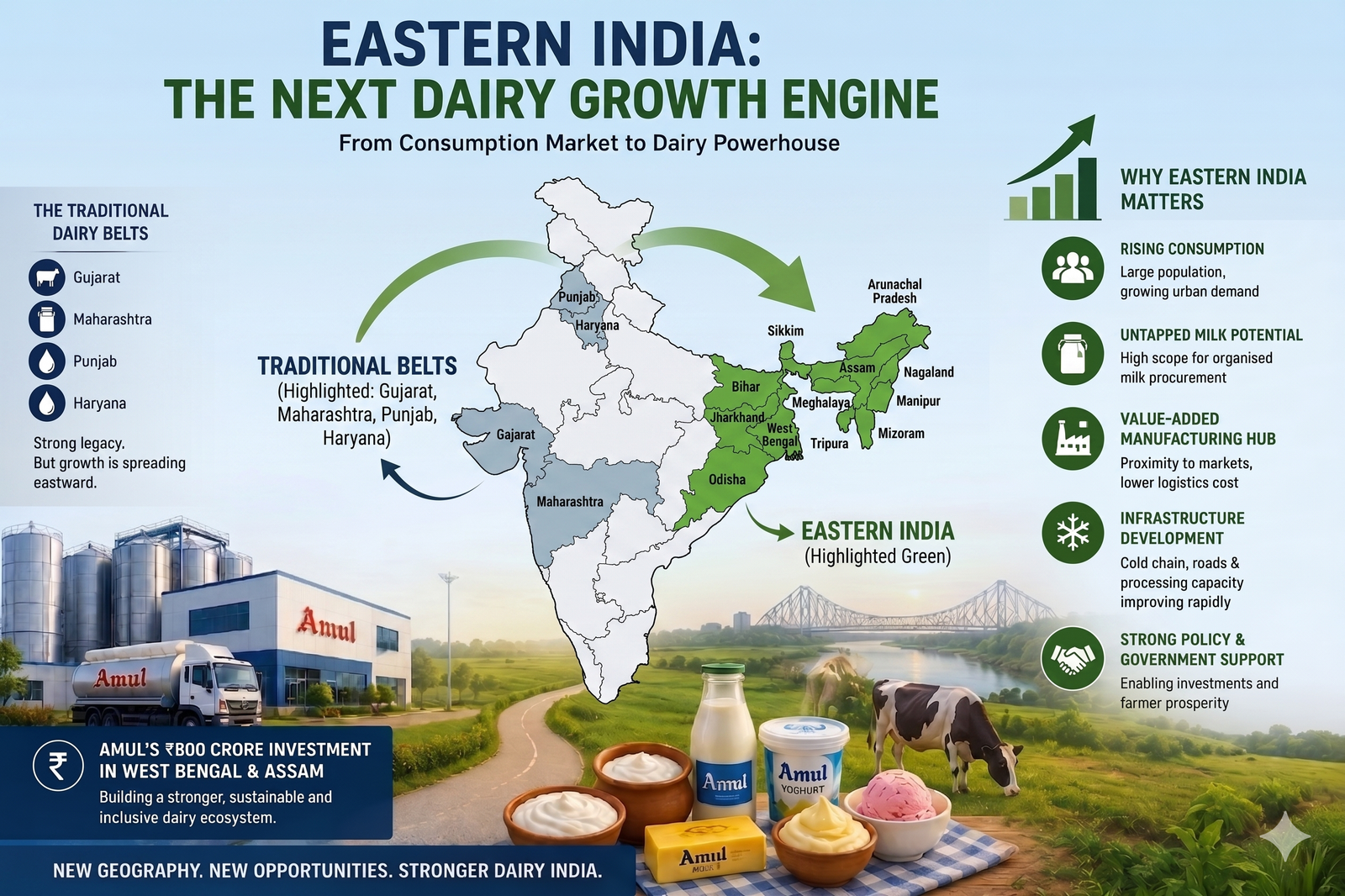
India’s largest dairy cooperative is making one of its boldest regional expansion moves yet, with Amul announcing investments worth nearly ₹800 crore across eastern and northeastern India. The projects include a ₹650 crore integrated dairy facility in West Bengal and a ₹150 crore processing plant in Assam, signalling a major transformation in how the Indian dairy industry views the eastern region.
Far from being a routine capacity addition, the investments reflect a deeper strategic shift underway in India’s dairy sector. Amul’s expansion demonstrates how eastern India is rapidly evolving from a consumption-led market into a critical hub for milk procurement, dairy processing, and value-added dairy manufacturing.
For decades, organised dairy operations in India were largely concentrated in states such as Gujarat, Maharashtra, Punjab, and Haryana. Eastern India remained dependent on transported dairy supplies, regional cooperatives, and fragmented local processors. That dynamic is now changing as dairy companies increasingly seek new milk sheds, regional manufacturing ecosystems, and proximity to fast-growing urban demand centres.
West Bengal Becomes a Strategic Dairy Manufacturing Hub
The largest component of Amul’s latest investment is the proposed ₹650 crore greenfield dairy complex at Sankrail Food Park in Howrah district near Kolkata. The facility is expected to process nearly 15 lakh litres of milk per day, making it one of eastern India’s most significant dairy infrastructure projects.
Importantly, the project goes beyond liquid milk processing. The plant is being designed as a diversified value-added dairy products hub, with manufacturing capabilities across milk, curd, butter, ghee, lassi, and ice cream. Industry attention is particularly focused on the facility’s proposed cultured dairy segment, which could reportedly include one of the world’s largest curd manufacturing operations with capacity nearing 1,000 tonnes per day.
This strategy aligns closely with changing dairy market trends in India. Eastern India, especially West Bengal, has a deeply rooted fermented dairy culture with strong consumer demand for curd, doi, yoghurt, and emerging probiotic dairy products. Rather than replicating a conventional milk-focused model, Amul appears to be localising its production strategy around regional consumption preferences.
The move also reflects the wider evolution of dairy economics in India. While liquid milk continues to operate on relatively thin margins, categories such as yoghurt, ice cream, cultured dairy, and value-added beverages offer stronger profitability, branding opportunities, and improved cold-chain efficiency.
Assam Project Strengthens Northeast Dairy Infrastructure
Alongside the Bengal expansion, Amul is investing approximately ₹150 crore in a new dairy processing facility near Guwahati in Assam. The plant is expected to be developed near Rani with an initial capacity of around one lakh litres per day, alongside future expansion potential.
Unlike the West Bengal project, which is strongly consumer-market focused, the Assam facility appears strategically aimed at developing milk procurement networks and strengthening organised dairy infrastructure across the Northeast.
The region has historically faced challenges related to fragmented milk production, limited processing capacity, and logistical constraints. Amul’s entry into Assam could accelerate formalisation through improved chilling infrastructure, structured procurement systems, milk testing, and stronger farmer integration. The Assam government has indicated that nearly 20,000 dairy farmers could benefit from the ecosystem built around the project.
Eastern India Emerging as India’s Next Dairy Growth Corridor
Industry experts increasingly believe that eastern India is becoming the next major frontier for organised dairy growth.
According to Prashant Tripathi, Director of Jordbrukare India, recent developments across the sector indicate a clear strategic pattern emerging in the region.
“If we look at the recent strategic moves across the industry — from Dodla Dairy’s acquisition of Osam Dairy, to Hatsun Agro Product’s acquisition of Milk Mantra, and now Amul’s ₹800 crore investment across West Bengal and Assam — a very clear pattern is emerging. Eastern India is no longer being viewed merely as a consumption market. It is increasingly becoming a strategic dairy geography for procurement, processing, value-added manufacturing, and long-term market expansion.”
He further noted that eastern India offers a unique combination of rising dairy demand, underdeveloped organised infrastructure, and significant headroom for milk procurement growth.
“Historically, most large dairy investments were concentrated around western and northern milk belts. Today, companies are recognising that the next phase of growth will require building new milk sheds and regional processing ecosystems. Eastern India is increasingly becoming central to that strategy.”
The trend is becoming increasingly visible across the Indian dairy industry. Dodla Dairy expanded its eastern footprint through the acquisition of Osam Dairy, while Hatsun Agro Product strengthened its regional presence through the acquisition of Milk Mantra. Amul’s latest investment significantly intensifies organised dairy competition across eastern India.
A New National Procurement Strategy for Indian Dairy
Perhaps the most important takeaway from Amul’s expansion is the evolution of its procurement strategy.
Historically, Amul’s operational strength was built around Gujarat’s highly efficient cooperative milk collection network. However, changing dairy market realities are now encouraging large processors to diversify milk sourcing geographically. Rising transportation costs, climate variability, growing urban demand, and increasing competition for quality milk are reshaping procurement economics across the Indian dairy industry.
Amul has steadily expanded procurement operations beyond Gujarat into states such as Maharashtra, Andhra Pradesh, Tamil Nadu, Punjab, Uttar Pradesh, Bihar, and now eastern India. The West Bengal and Assam facilities should therefore be viewed not simply as manufacturing plants, but as anchors for future regional dairy ecosystems.
In many ways, the cooperative is transitioning from a Gujarat-based dairy organisation with national distribution into a truly national dairy network with decentralised procurement and regionally distributed manufacturing hubs.
Why Eastern India Is Attracting Dairy Investments
Several structural factors are making eastern India increasingly attractive for organised dairy investment:
- Rapid urbanisation and rising disposable incomes in cities such as Kolkata, Guwahati, Ranchi, Bhubaneswar, and Patna
- Expansion of modern retail and quick-commerce platforms
- Growing demand for packaged dairy and value-added dairy products
- Lower organised dairy penetration compared to western India
- Improved cold-chain and logistics opportunities through local manufacturing
For products such as curd, yoghurt, and ice cream, localised production offers significant advantages in freshness, distribution efficiency, and temperature-controlled supply chains.
Competitive Impact on India’s Dairy Sector
Amul’s investments are likely to intensify competition across eastern India’s organised dairy market. Regional cooperatives and private dairy processors may now face pressure from a company with large-scale procurement capabilities, extensive distribution reach, strong brand recognition, and diversified dairy product categories.
At the same time, the expansion could accelerate formalisation across eastern India’s dairy ecosystem by improving milk quality systems, farmer training, cold-chain infrastructure, and organised procurement standards.
More importantly, the investments send a broader signal to the Indian dairy industry: future dairy growth will increasingly depend on regional manufacturing ecosystems, procurement diversification, value-added dairy production, and localised market strategies rather than reliance solely on traditional milk belts.
Amul’s eastern expansion may ultimately become one of the defining developments shaping the next phase of India dairy trends and organised dairy growth.