


Page 21 - Dairy Dimenison Aug-Sep24
P. 21
| Volume 1 | Issue 1 | Jul-Aug 2024  INTERVIEW                                  | Volume 1 | Issue 1 | Jul-Aug 2024


                                                                 two species Bos indicus and Bos tarus.
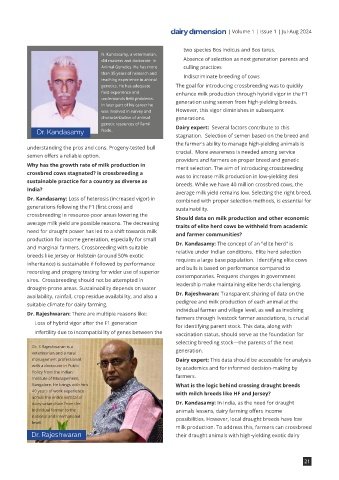
                                     N. Kandasamy, a veterinarian,
                                     did masters and doctorate  in   ·  Absence of selection as next generation parents and
                                     Animal Genetics. He has more   culling practices
                                     than 35 years of research and
                                                               ·  Indiscriminate breeding of cows
                                     teaching experience in animal
                                     genetics. He has adequate   The goal for introducing crossbreeding was to quickly
                                     field experience and      enhance milk production through hybrid vigor in the F1
                                     understands field problems.    generation using semen from high-yielding breeds.
                                     In later part of his career he
                                     was involved in survey and   However, this vigor diminishes in subsequent
                                     characterization of animal   generations.
                                     genetic resources of Tamil   Dairy expert:  Several factors contribute to this
              Dr. Kandasamy          Nadu.                     stagnation.  Selection of semen based on the breed and

                                                               the farmer's ability to manage high-yielding animals is
           understanding the pros and cons. Progeny-tested bull
           semen offers a reliable option.                     crucial.  More awareness is needed among service
                                                               providers and farmers on proper breed and genetic
           Why has the growth rate of milk production in       merit selection. The aim of introducing crossbreeding
           crossbred cows stagnated? Is crossbreeding a        was to increase milk production in low-yielding desi
           sustainable practice for a country as diverse as    breeds. While we have 40 million crossbred cows, the
           India?
                                                               average milk yield remains low. Selecting the right breed,
           Dr. Kandasamy: Loss of heterosis (increased vigor) in   combined with proper selection methods, is essential for
           generations following the F1 (first cross) and      sustainability.
           crossbreeding in resource-poor areas lowering the   Should data on milk production and other economic
           average milk yield are possible reasons. The decreasing   traits of elite herd cows be withheld from academic
           need for draught power has led to a shift towards milk   and farmer communities?
           production for income generation, especially for small   Dr. Kandasamy: The concept of an "elite herd" is
 Experts’ Opinion on Breeding   and marginal farmers. Crossbreeding with suitable   relative under Indian conditions.  Elite herd selection
           breeds like Jersey or Holstein (around 50% exotic
                                                               requires a large base population.  Identifying elite cows
 Strategies for Milk Production  inheritance) is sustainable if followed by performance   and bulls is based on performance compared to
           recording and progeny testing for wider use of superior
                                                               contemporaries. Frequent changes in government
           sires.  Crossbreeding should not be attempted in
           drought-prone areas. Sustainability depends on water   leadership make maintaining elite herds challenging.
 This first group interaction by DAIRY DIMENSION with   Development Board (NDDB) can restrict state control.   availability, rainfall, crop residue availability, and also a   Dr. Rajeshwaran: Transparent sharing of data on the
 seasoned dairy experts delves into the intricacies of   Dairy farmers, primarily engaged in dairying, are the key   suitable climate for dairy farming.  pedigree and milk production of each animal at the
 breeding practices and their impact on milk production   stakeholders and it is important to involve them for   Dr. Rajeshwaran: There are multiple reasons like:  individual farmer and village level, as well as involving
 in India. As Schneider (1948) aptly noted, breeders must   better policy decisions.  farmers through livestock farmer associations, is crucial
 consider various factors, including climate adaptability,   Dr. Rajeshwaran: Breeding policies need a complete   ·  Loss of hybrid vigor after the F1 generation  for identifying parent stock. This data, along with
 available feed, and the socio-economic context of   overhaul, focusing on consumer preferences for liquid   ·  Infertility due to incompatibility of genes between the   vaccination status, should serve as the foundation for
 livestock management. In this discussion, experts Dr.   milk, homemade products, and bulk markets.  Pooling   selecting breeding stock—the parents of the next
 Kandasamy, Dr. Rajeshwaran, and a dairy expert who   milk from all animals should be phased out beginning   Dr. S Rajeshwaran is a   generation.
            veterinarian and a rural
 requested anonymity share their insights on the impact   with separate collection and sale of milk from crossbred   management professional   Dairy expert: This data should be accessible for analysis
 of breeding policy, the scope of genetic improvement,   cows (A1 milk) and indigenous cows and buffaloes (A2   with a doctorate in Public   by academics and for informed decision-making by
 and the need for technological advancements.  milk). Breeding policies should be dynamic, district-  Policy from the Indian   farmers.
            Institute of Management,
 Are current breeding policies relevant to address   specific, and decided upon by farmers who raise parent   Bangalore. He brings with him   What is the logic behind crossing draught breeds
 present and future demands for milk production and   stock through Breeders' Associations. Professionals can   40 years of work experience   with milch breeds like HF and Jersey?
 nutrition?  guide proper implementation.  across the entire vertical of
            dairy value chain from the                         Dr. Kandasamy: In India, as the need for draught
 Dr. Kandasamy: Existing state breeding policies are   Dairy expert: The breeding policy needs revision.   individual farmer to the   animals lessens, dairy farming offers income
 broad generalizations. Supplying good quality frozen   Crossbreeding with exotic bulls like Holstein Friesian (HF)   national and international   possibilities. However, local draught breeds have low
 semen for insemination is more critical. Additionally,   and Jersey can continue, but farmers should be   level.  milk production. To address this, farmers can crossbreed
 intervention by organizations like the National Dairy   empowered to choose the breed and blood level after   Dr. Rajeshwaran  their draught animals with high-yielding exotic dairy


 20                                                                                                         21

