


Page 22 - Dairy Dimenison Aug-Sep24
P. 22
| Volume 1 | Issue 1 | Jul-Aug 2024                                INTERVIEW                                                                                              | Volume 1 | Issue 1 | Jul-Aug 2024


           breeds like Jersey or Holstein. This approach aims to   adequate irrigation.  Crop residue availability                testing, and sire selection.  We have an adequate gene   ET projects currently subsidized in some states?
           improve milk production without replacing a farmer's   significantly impacts milk yield (regardless of breed) and      pool to move forward.                               Dr. Kandasamy:  ET is for multiplying genetically
           main source of income.                              reproduction.  Water availability facilitates green fodder         Dr. Rajeshwaran: The import of frozen semen,        superior females. However, without milk recording data
           Dairy expert:  This strategy to increase milk yield in   cultivation.                                                  embryos, and bulls of specific breeds should be     for at least three lactations (and that of contemporaries)
           draught breeds is not recommended. Draught breeds   Dr. Rajeshwaran:  Data limitations prevent concluding              considered on a case-by-case basis, requiring thorough   for proper identification, selecting cows based solely on
           should be crossed with other draught breeds after   milk production by cows, crossbred cows, and buffaloes             academic evaluation, assessment of farmer needs and   absolute yields is not scientifically sound.  The top 5% of
           selection. With increased mechanization, farmers rely   in these states. Individual estimates for each category        acceptance, and a focus on maintaining biodiversity.   cows based on herd average are typically selected.
           less on draught breeds, which can now be crossed with   are unavailable.                                               However, the primary source of semen should be      Therefore, ET plays a minimal role in the genetic
           Indian dairy breeds.                                Dairy expert: Both states show an increase in the                  progeny-tested semen from high-pedigreed bulls, born   improvement of crossbred and indigenous cattle under
           What role can draught breeds play in India with the   crossbred population and a decrease in indigenous                to high-yielding parents within the region or country.   field conditions.  However, it can be used in institutional
           shift towards mechanized farming?                   breeds.  The average milk yield from crossbred cows is             While embryo transfer is an effective but costly method   herds to produce sires for progeny testing based on
           Dr. Rajeshwaran: There's immense potential for      higher than the national average due to selection and a            for obtaining a large number of embryos quickly from   nominated service.
           utilizing dung and urine from draught and milch cows for   larger number of animals in milk.                           specific parents, it does not influence the selection of   Dr. Rajeshwaran:  ET, as currently practiced, has
           biogas generation and using slurry as organic fertilizer.    How can genetic biodiversity be ensured within            bulls for breeding programs.                        minimal impact on milk production due to the low
           Micro-biogas units at the household level have proven   purebred populations?                                          Dairy expert:  India should stop importing semen and   number of calves involved and the uncertain quality of
           successful, providing economic benefits to farmers   Dr. Kandasamy: Avoiding mating among closely related              bulls, and instead focus on developing bulls through   calves born.  Additionally, the high cost of ET, coupled
           through reduced LPG and fertilizer costs.           animals and utilizing outcrossing with new sources from            progeny testing and Embryo Transfer technology.     with the additional dry days for the donor animal, makes
           Dairy expert: Draught breeds can still be valuable for   the same breed whenever available are recommended             What is the progress in developing indigenous       it economically unattractive for farmers.  Furthermore,
           small landholders in areas not yet fully mechanized.  practices.                                                       breeds like Rathi, Kankrej, Tharparkar, and Hariana   high calf mortality rates make ET an unviable option.
           What are the results of purebred cow breeding       Dr. Rajeshwaran: Farmers traditionally use bulls of the            through milk recording and pedigree selection?      Dairy expert:  The objective of ET should be to produce
           initiatives?                                        same breed for natural service, changing them every two            Dr. Kandasamy: Milk recording and reproduction      bulls for semen production, particularly in indigenous
           Dr. Kandasamy: The government encourages purebred   years. This practice helps maintain some level of genetic          recording are crucial starting points for genetic   breeds.
           herd establishment, but long-term success relies on   diversity.                                                       improvement programs.  However, pedigree selection   What are the views on using sex-sorted semen and
           farmer participation in their home tracts.  Government   Should India continue semen and bull import, or               alone has limited value and is not widely practiced in   gene editing?
           support for healthcare, scientific assistance, and   should we focus on progeny testing and Embryo                     advanced dairy countries.                           Dr. Kandasamy: Sex-sorted semen has a success rate of
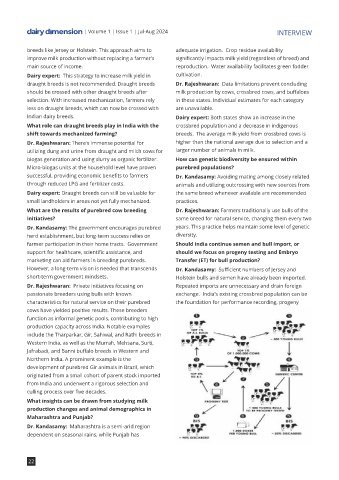
           marketing can aid farmers in breeding purebreds.    Transfer (ET) for bull production?                                 Dr. Rajeshwaran: Milk recording for all bovines,    around 95%, which is acceptable.  However, under field
           However, a long-term vision is needed that transcends   Dr. Kandasamy:  Sufficient numbers of Jersey and               especially future parent stock, should be mandatory.    conditions, a 30% conception rate with sex-sorted
           short-term government mindsets.                     Holstein bulls and semen have already been imported.               These animals need to be identified for breeding    semen is not achievable.  This rate is only attainable
           Dr. Rajeshwaran:  Private initiatives focusing on   Repeated imports are unnecessary and drain foreign                 purposes, with their calves becoming replacement    when inseminating heifers or first-calvers with no history
           passionate breeders using bulls with known          exchange.  India's existing crossbred population can be            breeding stock, particularly females.               of reproductive disorders.  Furthermore, sex-sorted
           characteristics for natural service on their purebred   the foundation for performance recording, progeny              Dairy expert: Milk recording for these breeds is on the   semen is expensive and not affordable for most farmers.
           cows have yielded positive results. These breeders                                                                     right track.                                        Dr. Rajeshwaran: Using sex-sorted semen on Indian
           function as informal genetic pools, contributing to high                                                               Is the current progeny testing project for Jersey and   cows and buffaloes would reduce biodiversity and
           production capacity across India. Notable examples                                                                     Holstein crossbreds a sound breeding policy, or     violate the biodiversity convention that India has signed.
           include the Tharparkar, Gir, Sahiwal, and Rathi breeds in                                                              should farmers focus on pure breeds?                Additionally, the semen quality is questionable.  Strict
           Western India, as well as the Murrah, Mehsana, Surti,                                                                  Dr. Kandasamy: Progeny testing programs for         monitoring and regulation of semen production are
           Jafrabadi, and Banni buffalo breeds in Western and                                                                     crossbreds are a sound approach.  Shifting entirely to   essential, with every frozen straw traced back to the
           Northern India. A prominent example is the                                                                             exotic purebreds like Holstein Friesian would be    inseminated cow/buffalo.  The bulls used for semen
           development of purebred Gir animals in Brazil, which                                                                   detrimental.  Farmers should be advised accordingly.  production must come from the top 1% of elite mothers.
           originated from a small cohort of parent stock imported                                                                Dr. Rajeshwaran: Progeny testing is a later stage in the   Without proper identification of these mothers, using
           from India and underwent a rigorous selection and                                                                      breeding process.  The initial focus should be on   sex-sorted semen is futile for enhancing milk production.
           culling process over five decades.                                                                                     segregating the "elite" stock of Indian breeds for   Dairy expert: The use of sex-sorted semen needs
           What insights can be drawn from studying milk                                                                          breeding purposes, separate from animals raised solely   further discussion with experts from various fields,
           production changes and animal demographics in                                                                          for milk production.                                including academics, farmers, geneticists, policymakers,
           Maharashtra and Punjab?                                                                                                Dairy expert: Progeny testing for Jersey and Holstein   and NGOs.
           Dr. Kandasamy:  Maharashtra is a semi-arid region                                                                      crossbreds can be continued.                        How can molecular markers be applied to select
           dependent on seasonal rains, while Punjab has                                                                          What should be the objectives and target breeds for   parent stock in cows?


           22                                                                                                                                                                                                                      23

