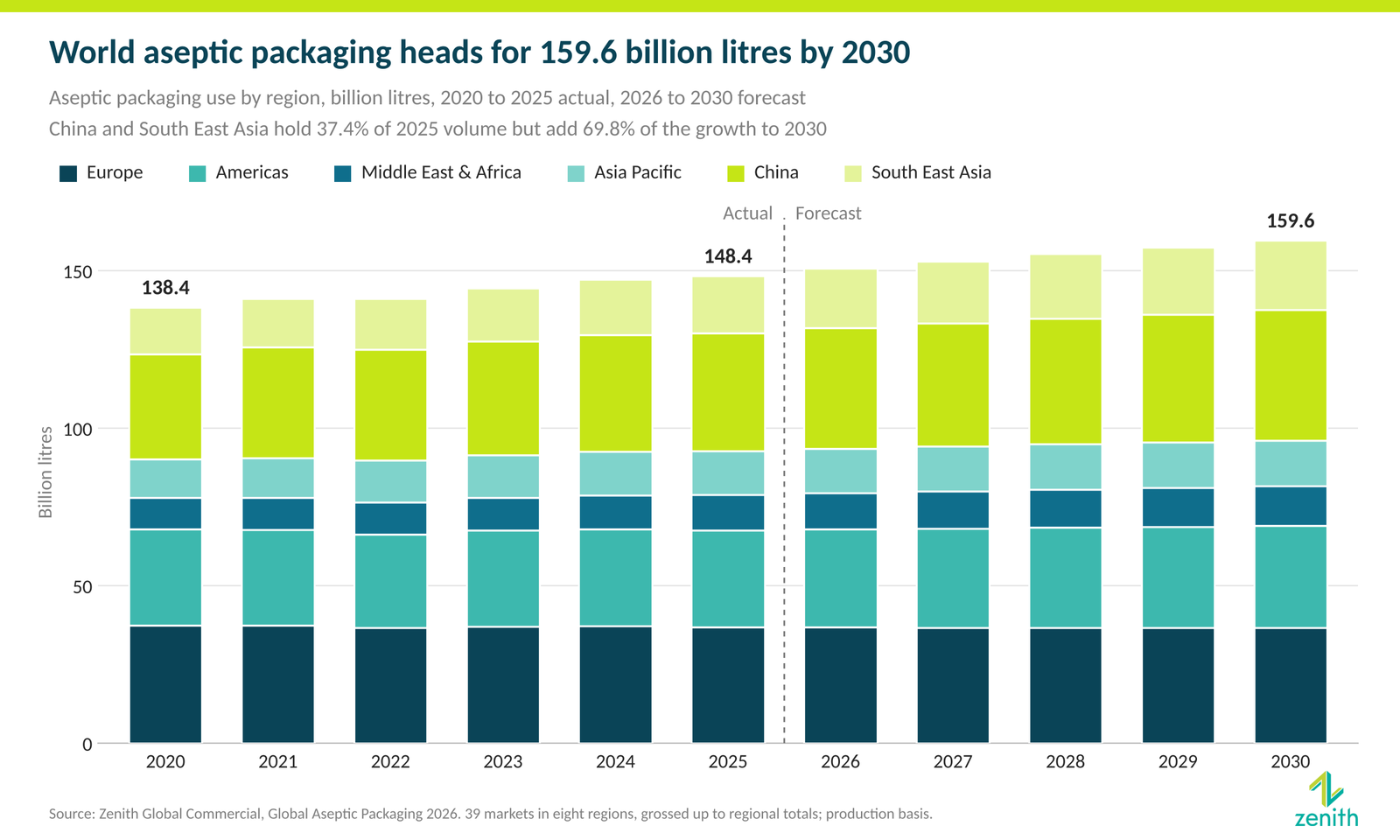
The global aseptic packaging market continued to expand in 2025, reaching 148.4 billion litres of product filled into 344.2 billion packs, according to new research published by Zenith Global Commercial. The study, Global Aseptic Packaging 2026, reports that worldwide volumes have grown at an average annual rate of 1.4% since 2020.
The report forecasts that global aseptic packaging volumes will increase to 159.6 billion litres and 370.5 billion packs by 2030, representing annual growth of approximately 1.5% between 2025 and 2030. Asia is expected to account for the largest share of this additional demand, with China and South East Asia emerging as the primary growth markets.
The findings highlight the continued importance of aseptic packaging in the dairy and beverage industries, particularly for products requiring extended shelf life without refrigeration before opening.
Dairy Products Account for More Than Half of Aseptic Volumes
Beverages represented the largest application of aseptic packaging in 2025, accounting for 60.2 billion litres, or 40.6% of global volume. UHT white milk followed with 52.7 billion litres, representing 35.5% of the total market.
Other dairy products contributed another 27.2 billion litres, equivalent to 18.3%, while food products accounted for 8.3 billion litres, or 5.6%.
Combined, white milk and other dairy products represented 53.8% of global aseptic packaging volumes. This demonstrates the significant role of aseptic technology in dairy processing, distribution and product preservation.
China remained the largest individual market, with 37.4 billion litres in 2025, accounting for approximately one-quarter of global consumption. West Europe followed with 27.2 billion litres, while Latin America recorded 19.7 billion litres. The average aseptic pack contained approximately 431 millilitres.
Asia Expected to Drive Market Expansion Through 2030
Global aseptic packaging volumes are projected to increase by 11.3 billion litres between 2025 and 2030. China is expected to contribute an additional 4.0 billion litres, while South East Asia is forecast to add 3.9 billion litres. Together, these markets will account for 69.8% of the projected increase in global demand.
Other regions expected to contribute to market expansion include the Middle East and Africa, with an additional 1.4 billion litres, and Latin America, with 1.1 billion litres.
South East Asia is forecast to be the fastest-growing region, recording annual growth of 4.0% through 2030. Although it currently represents 12.2% of global aseptic packaging volume, the region is expected to contribute 34.4% of total market growth over the forecast period.
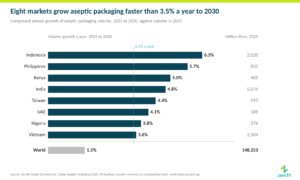
At the country level, Indonesia is projected to record the highest annual growth rate at 6.3%, followed by the Philippines, Kenya, India and Taiwan. Eight markets are expected to achieve annual growth exceeding 3.5%.
In contrast, West Europe is forecast to be the only region experiencing an overall decline, with volumes decreasing by 0.4% annually. Germany and France are each projected to register an annual decline of 1.2%.
PET Bottles Gain Ground as Product Demand Changes
The study also identifies differences in growth across product categories and packaging formats. Beverages are expected to remain the fastest-growing product category, increasing by 2.3% annually to reach 67.3 billion litres by 2030.
Other dairy products are forecast to grow by 2.0% annually, while UHT white milk is expected to record more moderate growth of 0.4%. Food products are projected to increase by just 0.2% annually.
Cartons continue to dominate the aseptic packaging landscape, accounting for 66.5% of global volume and 91.8% of aseptic UHT milk packaging. However, PET bottles are gaining market share.
PET packaging is projected to grow by 3.7% annually through 2030, compared with 0.7% for cartons. Consequently, PET’s share of global aseptic packaging volume is expected to rise from 25.2% in 2025 to 28.1% by 2030.
The report also compares aseptic filling with other ambient beverage packaging technologies. Aseptic filling currently accounts for 38.9% of ambient long-life beverage volumes, compared with 42.6% for hot filling. By 2030, the gap is expected to narrow, with aseptic filling reaching 40.0% and hot filling accounting for 40.5%.
Market Intelligence Highlights Regional Opportunities
According to Akos Petri, Managing Director of Zenith Global Commercial, the aseptic packaging industry continues to expand, but its growth opportunities are increasingly concentrated in Asia. He highlighted the importance of understanding regional demand, product categories and packaging formats when making investment and business decisions.
The fifth edition of Global Aseptic Packaging 2026 examines 39 markets across eight regions, covering white milk, other dairy products, beverages and food products. It includes actual data from 2020 to 2025 and forecasts through 2030, with volumes measured in both litres and packs. The research is presented in a report exceeding 900 pages, alongside a separate supplier report.
For dairy processors, packaging manufacturers and brand owners, the findings point to the growing importance of emerging Asian markets, changing consumer demand and competition between packaging formats. The projected expansion of aseptic packaging could create opportunities for dairy companies seeking to improve product shelf life, expand distribution networks and reach consumers in markets with developing cold-chain infrastructure.