The global cheese market continues to grow, supported by rising consumer demand, expanding production capacity and increasing international trade. Global cheese trade has grown by approximately 40% since 2017, as major dairy-producing regions continue to invest in processing capacity.
However, price movements are becoming increasingly different across cheese categories, with cheddar prices weakening while mozzarella prices gain support from tighter European milk supplies.
Cheddar Prices Under Pressure
According to Global Dairy Trade data, cheddar prices have declined by 6.5% over the past year, reaching approximately €3,138 per tonne.
The decline has been linked to increased milk availability in major producing regions, particularly the United States and New Zealand.
The expansion of cheese-processing capacity in the US is also adding pressure to cheddar prices. As more milk is directed towards cheese production, growing output could keep supplies relatively high and limit price increases.
Mozzarella Prices Move Higher
Mozzarella has followed a contrasting trend.
Prices increased by 1.3% year-on-year to approximately €3,448 per tonne, supported by tighter milk supplies in Europe following periods of extreme heat.
As a result, mozzarella is currently trading above cheddar—a notable reversal because cheddar has traditionally commanded a premium over mozzarella.
According to Rabobank, a similar situation was last observed in the European Union in 2019.
European Milk Supply Faces Growing Pressure
Milk availability is emerging as one of the most important factors influencing cheese prices.
Milk production in the United States increased by around 2% over the past year, while New Zealand recorded growth of approximately 4%.
Further production growth is expected in the US, Australia and New Zealand, potentially providing processors with additional milk for cheese production.
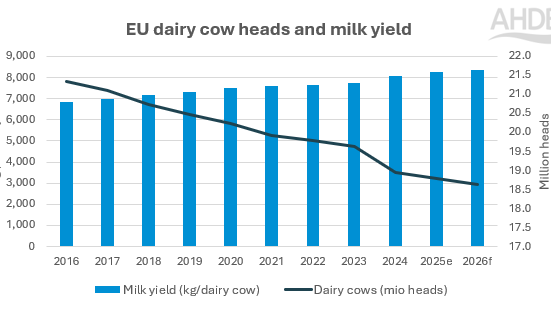
The outlook for Europe is considerably weaker.
European dairy producers continue to face elevated fuel and fertiliser costs, while milk prices are reportedly around 30% lower than a year ago. At the same time, heatwaves have affected milk production in several European markets.
US Production Expansion Could Weigh on Cheddar
The United States is continuing to expand its cheese-processing capacity, creating the potential for further growth in cheddar production.
With milk supplies also increasing, additional production could keep cheddar markets well supplied.
This could make it difficult for cheddar prices to recover significantly unless demand strengthens or milk production growth slows.
Mozzarella Could Receive Continued Support
Mozzarella could benefit from the opposite supply dynamic in Europe.
If European milk production remains constrained by weather conditions and high production costs, processors could face tighter availability of milk for cheese manufacturing.
This could provide continued support to mozzarella prices, particularly if demand remains strong.
However, the price outlook will ultimately depend on how quickly milk production recovers across Europe and whether global supplies from other producing regions can compensate for the shortfall.
Global Cheese Trade Continues to Expand
The global cheese trade has increased by approximately 40% since 2017, highlighting the growing importance of international dairy markets.
Greater trade is creating opportunities for major cheese-producing regions but is also increasing competition between suppliers.
As production capacity expands in the US and other exporting regions, competition for international markets is likely to intensify.
Outlook for the Global Cheese Market
The global cheese market could see increasingly divergent price movements in the coming months.
🇺🇸 US: Rising milk production and expanding cheese capacity could put continued pressure on cheddar.
🇳🇿 New Zealand: Higher milk production could contribute to stronger global cheese supplies.
🇪🇺 European Union: Tighter milk availability and high input costs could support prices for products such as mozzarella.
🌎 Global market: Increasing cheese trade will intensify competition between major producing and exporting regions.
The key factor to watch will remain milk supply. A continuation of strong production growth in the US and Oceania could weigh on global cheese prices, while persistent supply constraints in Europe could keep selected varieties such as mozzarella relatively firm.