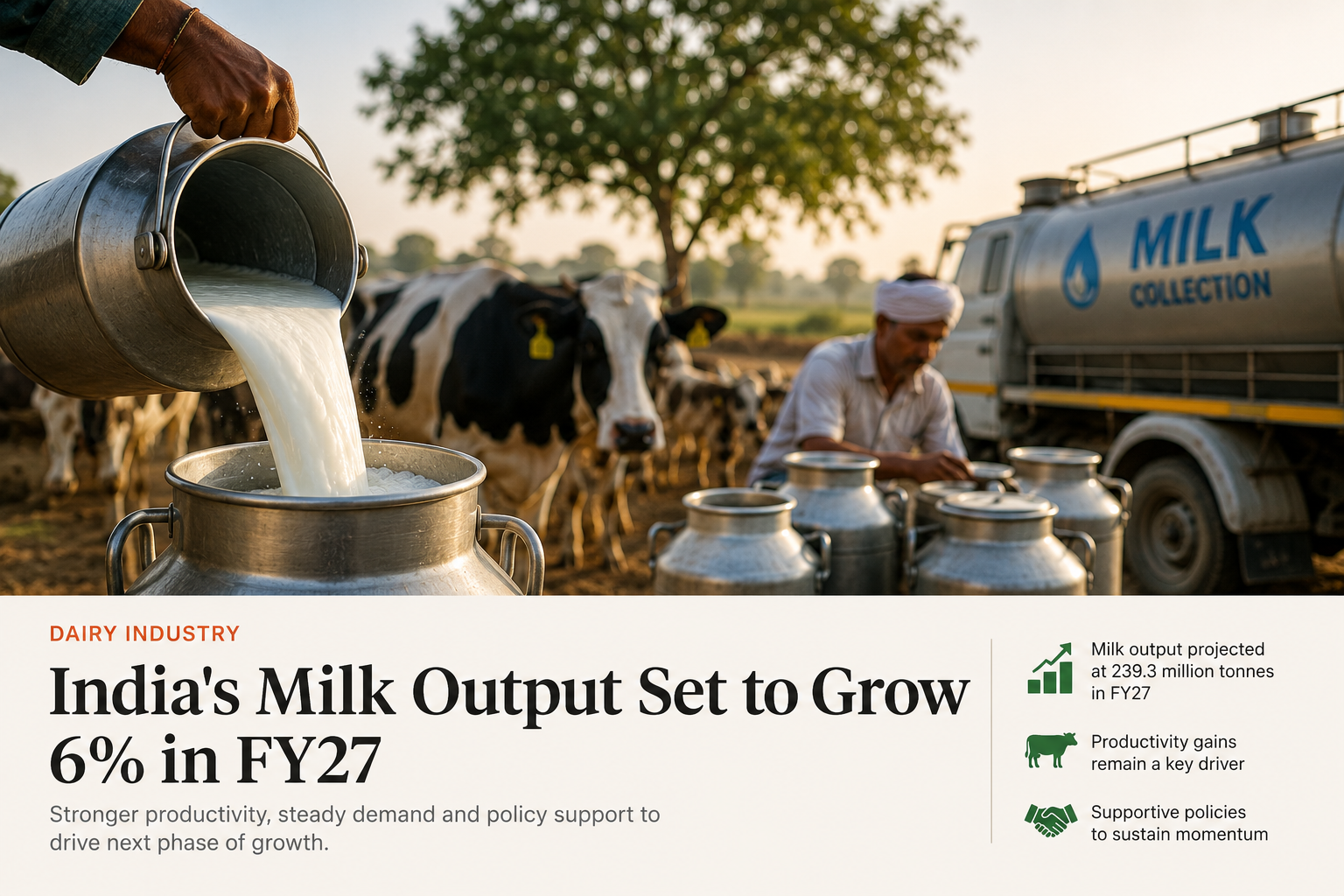
India’s Milk Output Set to Grow 6% in FY27 — But the Herd Tells a More Complex Story
India remains the world’s largest milk producer by volume, and its FY27 growth trajectory looks intact at around 263 million tonnes. But beneath the headline forecast lies a productivity story, not a population story — and a potentially weak monsoon could stress-test that distinction in the months ahead.
India’s dairy sector is heading into FY27 with a familiar forecast: robust volume growth. Production is projected to reach approximately 263 million tonnes, up roughly 6% from an estimated 248 million tonnes in FY26 — extending what is now a three-decade unbroken upward curve. Yet beneath the headline number lies a structural story that deserves closer scrutiny: India’s growth is increasingly a productivity story, not a population story, and a potentially weak monsoon season could stress-test that distinction in the months ahead.
A Record Built Over Thirty Years
The scale of India’s dairy transformation is difficult to overstate. In 1991–92, the country produced 55.6 million tonnes of milk. By 2023–24, that figure had risen to 239.3 million tonnes — a 4.3-fold increase in just over three decades, achieved without any fundamental restructuring of farm scale or ownership. India remains a nation of smallholder dairymen, yet it is the world’s single largest milk producer, accounting for roughly 24% of global output.
Per capita availability tells an equally striking story. From 178 grams per person per day in 1991–92, availability reached 471 grams/day in 2023–24 — comfortably above the ICMR recommended minimum of 300 grams and closing in on global consumption benchmarks. This is not a sector stagnating; it is one that has tripled per capita output while absorbing a population increase of nearly 500 million people.
The compound annual growth rate over the last decade (FY14–FY24) has averaged approximately 5.7% — a figure that stands in sharp contrast to global dairy’s 2% annual growth, and one that the FY27 projection of 6% sits broadly in line with.
Per capita g/day (right)
What Is Driving Growth
Industry analysts cite a cluster of reinforcing factors behind the FY27 outlook.
Infrastructure expansion. The addition of an estimated 75,000 new dairy cooperatives deepens procurement reach into Tier 2 and 3 villages, extending the formalised milk supply chain further into the unorganised segment. More milk entering organised channels means better input services, veterinary access, and price signals flowing back to the farm.
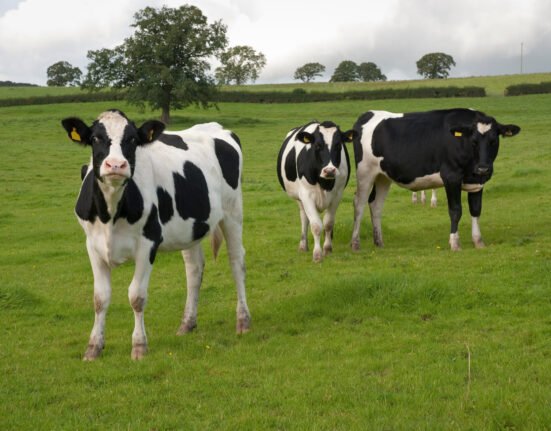
Breeding and productivity gains. Artificial insemination coverage has expanded substantially, with cross-bred animals increasingly replacing low-yielding desi cattle in major milkshed states. A cross-bred cow in Punjab or Gujarat produces 8–12 litres per day; a typical desi cow delivers 2–4. As the share of higher-yielding animals rises, aggregate production grows even when total herd size is flat or declining.
Veterinary services and disease management. The FMD and Brucellosis control programme has made measurable progress. The Lumpy Skin Disease outbreak of 2022 — which dented production in the northwest — has not recurred at scale, and animal health awareness at the farm level has improved.
Government support. The Animal Husbandry Infrastructure Development Fund (AHIDF) continues to channel capital into processing capacity and farm-level investment. Higher farmgate prices — underscored by Amul and Mother Dairy’s pan-India ₹2/litre price hike in May 2026 — also improve producer incentives.
The Animal Numbers: A Structural Shift Hidden in Plain Sight
To understand India’s dairy growth, one must look not at total livestock counts but at the composition of the productive herd. The Livestock Census series reveals a nuanced picture.
Buffalo population grew from 43.4 million in 1951 to a peak of approximately 109.9 million in 2019 — a 2.5x increase. Buffalo remain the backbone of India’s commercial dairy economy, particularly in the Indo-Gangetic Plain. Their milk is richer in fat and SNF, commands a premium for ghee and paneer manufacture, and is the primary feedstock for the country’s most commercially significant dairy cooperatives. At the national level, buffalo contribute roughly 49% of total milk output despite being a smaller absolute herd.
Cattle tell a more complicated story. Total cattle numbers have fluctuated — 155.3 million in 1951, rising to 204.6 million by 1992, then declining to 185.2 million in 2003 before recovering to 192.5 million in 2019. What has grown substantially is the adult female cattle population: from 54.4 million in 1951 to 81.4 million in 2019 — a 50% increase concentrated almost entirely in cross-bred and improved indigenous breeds.
Adult female cattle
Total buffalo
Adult female buffalo
The implication for FY27 is significant: production growth no longer requires proportional growth in the milking herd. It requires that existing animals are better fed, better managed, and better bred. This is simultaneously a source of resilience — you cannot lose animals you do not have — and vulnerability, as a fodder shock hits harder when margins per animal are already thin.
The Monsoon Risk: Why It Matters More Than It Once Did
The India Meteorological Department has revised its FY27 monsoon forecast to approximately 90% of the Long Period Average (LPA) — technically “normal” but at the lower bound of that range. An emerging El Niño pattern raises the spectre of uneven spatial distribution, with dairy-dense states in Rajasthan, Madhya Pradesh, and UP potentially caught in the deficit zone.
The dairy sector’s exposure to monsoon variability operates through three channels. Fodder availability: green fodder from kharif crops — bajra, maize, sorghum — is the primary feed input for milking animals across the unorganised sector. A weak monsoon compresses availability from August through November, historically the flush season. Paradoxically, poor fodder in the flush season reduces the production surge that ordinarily cushions the lean-season trough.
Water access for livestock — particularly in Rajasthan and Marathwada — is a serious operational constraint for small herders lacking borewell access. And rural income effects run deeper still: weak monsoon reduces crop income, which reduces the capacity to invest in supplemental feed, veterinary care, or herd additions. The causal chain is not instantaneous, but its effect on production typically shows in the second half of the affected fiscal year and into the following one.
Rajasthan’s outsized role makes this risk particularly material. With 34.7 million tonnes produced in FY24, Rajasthan has become India’s second-largest milk-producing state — a rise from 7.8 million tonnes in 2001–02 that represents a 4.5x increase in 22 years, driven almost entirely by the buffalos and cross-bred cattle of the Shekhawati, Bikaner, and Mewar belts. A below-average monsoon in eastern Rajasthan could exert disproportionate drag on national aggregates.
State-Level Divergence: Where the Growth Is Coming From
The state-level production data over the past two decades reveals that India’s dairy growth story is not uniform. A clear two-tier structure has emerged between high-growth states expanding from lower bases and mature milksheds plateauing on legacy infrastructure.
FY 2023–24
High-growth states driving the national aggregate upward include Rajasthan (34.7 MT in FY24, up from 7.8 MT in FY02), Madhya Pradesh (21.3 MT, up from 5.3 MT), Karnataka (13.5 MT, up from 4.8 MT), Maharashtra (16.0 MT, up from 6.1 MT), and Uttar Pradesh (38.8 MT, the largest single-state producer). These five states collectively account for well over half of national output and their growth trajectories remain steep.
Mature or plateauing states — Punjab, Haryana, and Andhra Pradesh — show flatter curves. Punjab produced 14.0 MT in FY24 versus 7.9 MT in FY02, a doubling over 22 years, but its share of national output has steadily declined. Rural-to-urban migration, rising labour costs, and the competitive pull of other agricultural activities have constrained herd expansion in these legacy milksheds.
This geographic shift has implications for quality and traceability. The newer milksheds of Rajasthan and MP are less penetrated by organised procurement, more reliant on aggregators and local dairies, and harder to reach with cold chain and testing infrastructure — a point of relevance for processors investing in quality assurance programmes.
Organised vs. Unorganised: The Structural Fault Line
One figure is easy to miss in production statistics: the organised sector — cooperatives and private licensed dairies — handles only around 30–35% of total milk produced in India. The remainder flows through informal channels: local milk vendors, small sweet shops, and direct farm-to-consumer arrangements.
This means that even as production grows at 6% per year, the commercially accessible and quality-assured milk pool grows more slowly unless organisational penetration deepens. Cooperative expansion — including the 75,000 new cooperatives cited for FY27 — is therefore as important as raw volume growth for the investable dairy economy.
The May 2026 price hike by Amul and Mother Dairy reflects tightening in the organised segment specifically: procurement competition from private players, rising input costs, and the need to sustain farmer loyalty. Farmgate price improvement, in turn, is the most durable signal to encourage herd investment by smallholders.
The Productivity Imperative
If the buffalo and cattle numbers confirm anything, it is that India cannot simply add animals indefinitely. The country’s livestock density is already among the highest in the world relative to land area; feed and fodder constraints are systemic; and the environmental footprint of maintaining a 300-million-bovine herd is increasingly in policy conversations.
The path to sustained 5–6% production growth runs through yield per animal, not headcount. Cross-breeding coverage, quality semen distribution, nutrition supplementation, and disease control are the levers. GCMMF’s affiliated member farmers in Gujarat consistently achieve yields per cross-bred cow that are 3–4 times the national average for desi cattle. Scaling that model to the Rajasthan desert belt or the smallholder farms of Bihar is the generational challenge facing Indian dairy.
Outlook
India’s 6% FY27 growth target is achievable under normal weather conditions and credible given structural momentum. The risks are not existential but they are real: a weak monsoon could shave 1–2 percentage points off actual growth, particularly if it concentrates in the northwest milkshed states. A second LSD-type disease event, or a repeat of the foot-and-mouth spike, would be more disruptive.
< 6% growth
FY27 target (6%)
The longer arc is not in doubt. India has added roughly 100 million tonnes of production capacity over the last 15 years, reaching 239 million tonnes in FY24. The trajectory to 300 million tonnes — the figure most analysts project by the early 2030s — is not a straight line, but it is a credible one, grounded in demographics, income growth, and a livestock base that, for all its informal character, has proven remarkably resilient.
For processors, investors, and dairy technology suppliers evaluating India, the FY27 forecast is less interesting as a single number than as a signal: the sector’s fundamentals remain intact, its geography is shifting southward and westward, and the productivity-led growth phase is just beginning.