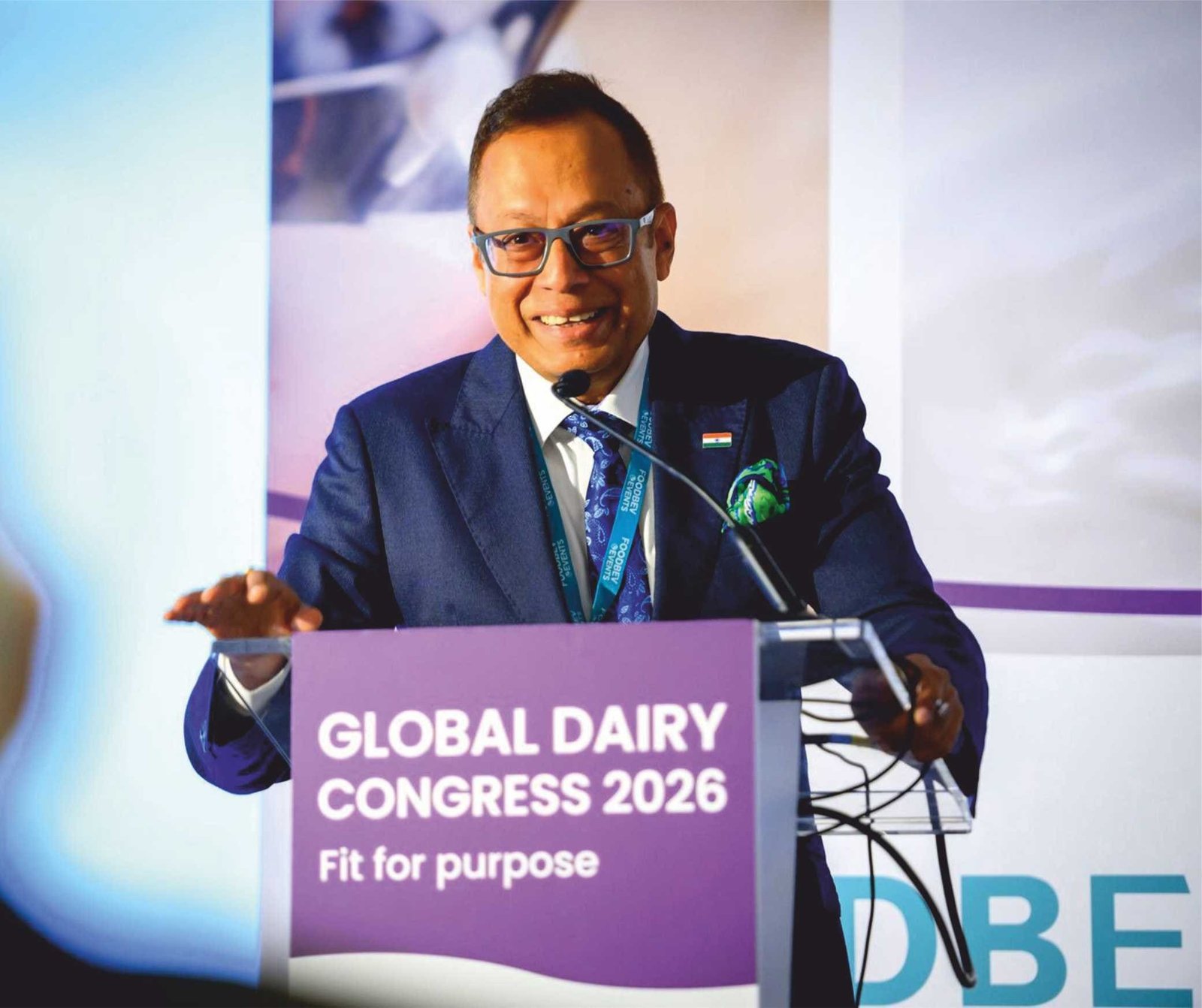
The 19th Global Dairy Congress, held in Barcelona on 17–18 June 2026, brought together senior executives, scientists, innovators and policymakers from across the global dairy value chain. Representatives from Yili, Morinaga, Nestlé, Fonterra, Lactalis, Bel, Roquette, Sidel, Vinamilk and many other leading companies joined delegates from Europe, Asia, Oceania and the Americas to discuss the future of dairy, nutrition, sustainability and innovation.
One of the sessions that attracted considerable interest was Rajiv Mitra’s address on “India’s Key Dairy Opportunities.” Rather than focusing solely on India’s impressive scale, it explored how the world’s largest milk-producing nation can become an increasingly important contributor to global nutrition, dairy proteins and value-added dairy products over the coming decade.
The World Has Largely Won the Battle for Calories
Over the past six decades, global food systems have undergone a remarkable transformation. Since 1960, agricultural production has grown significantly faster than the world’s population. Wheat, rice, maize, fruits, vegetables, milk, eggs and meat production have all expanded dramatically, enabling humanity to largely overcome the widespread food shortages once feared by many experts.
The Green Revolution and sustained improvements in agricultural productivity have strengthened not only global food security but also economic stability.
Today’s challenge, however, is no longer producing enough calories. The next frontier is affordable nutrition—and, increasingly, quality protein.
India’s Agricultural Success Story
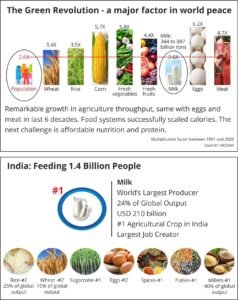 India’s own agricultural journey reflects this global transformation. Today, the country ranks among the world’s leading producers of rice, wheat, sugarcane, eggs, pulses, spices and millets, while achieving food self-sufficiency for a population of more than 1.4 billion.
At the heart of this success is dairy. Milk is India’s largest agricultural commodity, valued at more than USD 200 billion annually. The country produces around one-quarter of the world’s milk, making it the largest milk producer globally.
What makes this achievement exceptional is that it has been built not on large industrial farms but on the efforts of millions of smallholder farmers.
More Than Milk: The Social Impact of Dairy
In India, dairy is far more than an agricultural business. It supports the livelihoods of more than 90 million rural households and contributes nearly 5 per cent of the country’s GDP and around one-quarter of agricultural GDP.
Its impact extends well beyond milk production:
Women’s empowerment – In many rural households, women manage dairy income, strengthening financial inclusion and economic independence.
Employment generation – The sector creates jobs across farming, processing, logistics, veterinary services, retail and manufacturing.
Animal welfare – Better genetics, nutrition and healthcare improve both productivity and animal well-being.
Rural development – Daily milk payments provide a reliable source of cash flow, making dairy one of India’s most inclusive rural industries.
Few sectors combine commercial opportunity with social impact on such a scale.
Seven Opportunities That Could Shape Indian Dairy
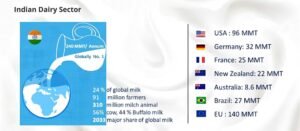 Building on this strong foundation, India’s dairy industry now has seven major opportunities that could define its next phase of growth.
- Farm Productivity
India’s low average milk yield presents one of the industry’s biggest growth opportunities. While dairy farms in many developed markets achieve average yields of more than 25 litres per animal per day, productivity in India remains significantly lower. Improvements in genetics, breeding, sexed semen, feed and nutrition, animal health, precision livestock management and modern farming practices can substantially increase output. Every additional litre of milk produced from an existing animal also improves sustainability by reducing the need for herd expansion.
- Expansion of the Organised Sector
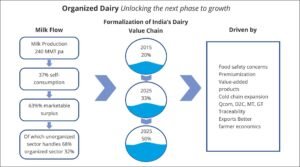
Despite its scale, India’s dairy industry remains largely fragmented, with a significant share of milk still sold through informal channels. Rising consumer demand for food safety, traceability, convenience and quality is accelerating the shift towards organised dairy. Continued growth in modern retail, quick commerce, digital commerce and cold-chain infrastructure will further support formalisation, benefiting consumers while improving quality assurance and price realisation for farmers.
This transition benefits both consumers and farmers through improved quality assurance and better price realisation for farmers.
- Value Addition and Premiumisation
India continues to convert much of its milk into relatively low-value products. However, rising incomes and changing consumer preferences are creating strong demand for value-added products such as cheese, yoghurt, fermented dairy, lactose-free dairy, functional nutrition products and premium traditional dairy offerings. The industry is steadily shifting from a volume-led to a value-led growth model.
- The Dairy Protein Opportunity
 One of the most significant opportunities for India’s dairy industry lies in dairy proteins.
Protein has moved beyond sports nutrition to become a mainstream dietary priority. This shift is being driven by three key trends: ageing populations seeking higher protein intake to support healthy ageing and muscle retention; growing consumer preference for high-protein diets; and the rapid adoption of GLP-1-based weight-management therapies, which are encouraging greater demand for nutrient-dense, protein-rich foods.
As a result, dairy protein consumption is expanding well beyond powders into yoghurts, ready-to-drink beverages, snacks, bakery products, ice cream and everyday fortified foods. At the same time, constrained global processing capacity has tightened supply, contributing to higher whey protein concentrate prices in recent years.
India has historically been a predominantly fresh dairy market, with limited cheese consumption and whey often regarded as a low-value by-product. That is now beginning to change, supported by rising cheese demand, investments in cold-chain and cheese-making infrastructure, and the growing adoption of Western dairy formats.
With strong milk production, a large farmer base and expanding processing capabilities, India is well positioned to emerge as a significant supplier of dairy proteins and specialised dairy ingredients for both domestic and global markets.
- Circular Dairy Economy
Technology is becoming a key driver of competitiveness in the dairy industry. Precision livestock management, AI-driven quality systems, traceability platforms, digital farmer ecosystems and smart logistics are improving productivity, food safety, transparency and farmer engagement across the value chain.
- Technology and Digital Dairy
Technology is becoming a key driver of competitiveness in the dairy industry. Precision livestock management, AI-driven quality systems, traceability platforms, digital farmer ecosystems and smart logistics are improving productivity, food safety, transparency and farmer engagement across the value chain.
- Export Growth
Despite being the world’s largest milk producer, India accounts for less than one per cent of global dairy exports, highlighting a significant growth opportunity. Milk powders, ghee, butter, anhydrous milk fat and specialised dairy ingredients offer strong export potential, particularly in Southeast Asia, Africa, Central and West Asia, as well as ethnic markets in developed countries.
The challenge will be to expand exports while maintaining India’s commitment to food security, rural livelihoods and farmer welfare.
Looking Ahead
By 2035, India is likely to play a much larger role in global dairy through protein ingredients, value-added products, digital innovation, sustainable production and stronger export participation. The industry’s future is not simply about producing more milk, but about creating greater value, improving productivity and becoming a more influential contributor to global nutrition.
Having transformed itself from a milk-deficient nation into the world’s largest milk producer, India is now well positioned to help meet the world’s growing demand for high-quality nutrition and dairy proteins.
That growing international interest was evident throughout the Global Dairy Congress in Barcelona, where delegates were keen to understand the scale and potential of India’s dairy ecosystem. Wanxing Eugene Ho of Mengniu Dairy said he had “benefitted greatly” from the insights shared on India, while Richard Hall, Chair of FoodBev Media and founder of the Global Dairy Congress, described India as “such an important contributor to the dairy world.” Industry leaders from New Zealand, Europe and Asia also recognised India’s growing influence in shaping the future of global dairy.
Such recognition brings responsibility. The next phase of India’s dairy journey will depend on improving farm productivity, expanding value-added products, building globally competitive dairy ingredient businesses, strengthening sustainability and increasing exports while maintaining its commitment to food security, rural livelihoods and farmer welfare.
The foundations have already been laid by millions of farmers, cooperatives, entrepreneurs, scientists and policymakers. If India can successfully combine its scale with innovation and efficiency, it has the potential to become not only the world’s largest dairy producer, but also one of its most influential dairy leaders.
The message from Barcelona was clear: the world is watching India’s dairy sector. The next chapter will be defined by how effectively India transforms that interest into global leadership.