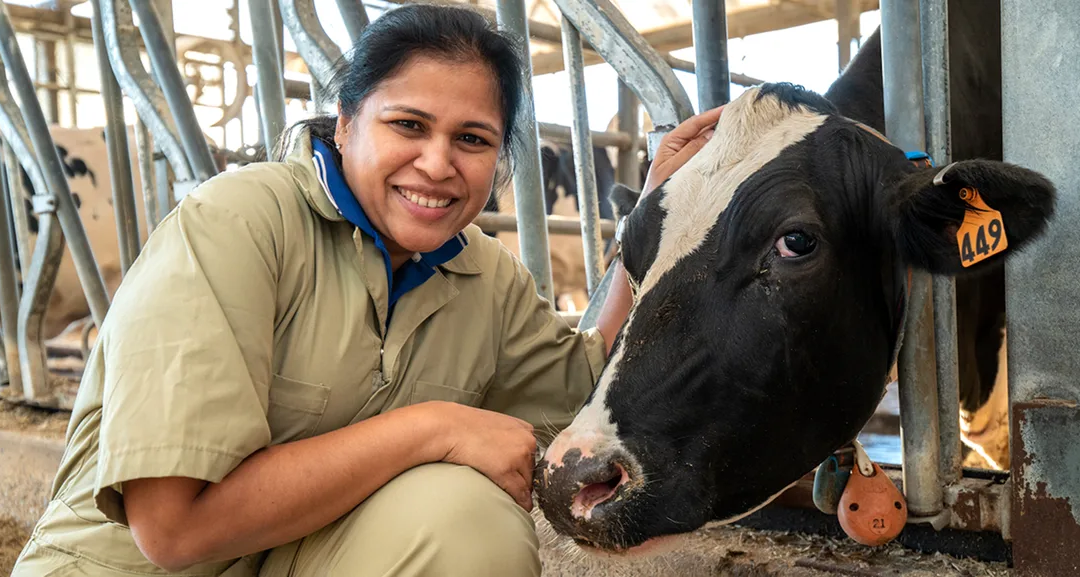
The University of Pennsylvania’s School of Veterinary Medicine (Penn Vet) is set to strengthen dairy cattle health research and education through a new calf nursery and dedicated housing facilities for growing and breeding heifers. The project is supported by a $1.5 million grant awarded to Dipti Pitta, professor of ruminant nutrition, by the U.S. Department of Agriculture’s National Institute of Food and Agriculture (USDA-NIFA).
The new facilities will be established at Penn Vet’s Marshak Dairy, creating an opportunity to study dairy animals from birth through their first lactation. The initiative aims to improve understanding of how early-life care influences long-term animal health, welfare, productivity and resilience.
Studying Dairy Cattle from Birth to First Lactation
Early-life management plays an important role in determining a dairy cow’s future performance. However, the long-term effects of interventions during the calf and heifer stages are not yet fully understood.
The project will enable researchers to monitor animals throughout their early development and transition into the milking herd. By collecting data across these stages, the team aims to establish evidence-based benchmarks for raising healthier and more productive dairy cattle.
Pitta, who is directing the project, said that following animals from birth through their first lactation, combined with automated feeding and precision monitoring, will help researchers understand how early-life care translates into long-term outcomes.
The findings are expected to support better-informed management decisions for dairy producers while expanding scientific knowledge of cattle health and performance.
Automated Feeding and Precision Monitoring
The project will be completed in phases, with dedicated spaces for neonatal calves, growing heifers and lactating heifers. The final phase will introduce automated feeding systems, environmental controls, behavioural monitoring and other precision technologies.
These systems are expected to help researchers collect more detailed information about animal development, feeding patterns and welfare. Continuous monitoring could also improve understanding of how management practices affect growth and prepare heifers for entry into the milking herd.
The resulting longitudinal database will cover multiple stages of development, providing a valuable resource for investigating the relationship between early-life management and subsequent productivity.
Supporting Dairy Farmers and Veterinary Education
Beyond research, the new facilities will serve as a practical training environment for veterinary and animal science students pursuing careers in dairy production and animal health.
The Marshak Dairy will also function as a demonstration site where dairy producers can learn about technologies, research findings and management practices that may be applied to their own operations.
By connecting scientific research with practical dairy farming, the initiative aims to help translate findings into approaches that support animal welfare, farm productivity and more resilient dairy production systems.
The project’s potential benefits extend to producers seeking reliable evidence to guide calf-rearing decisions, improve heifer development and support healthier cows as they enter their first lactation.
Research into the Early-Life Microbiome
Pitta leads the Agricultural Systems and Microbial Genomics Laboratory, which investigates the microbial composition of the ruminant gut. The laboratory’s work explores ways to improve animal health, production and welfare while reducing methane emissions.
Understanding the early-life microbiome is an important part of this research, as microbial development may influence how calves grow and perform later in life. The new facilities will provide infrastructure for research that follows animals over an extended period, supporting a more comprehensive understanding of these connections.
The USDA grant’s matching requirement will be met through a combination of institutional support, complementary grant programmes, philanthropy and corporate sponsorships.
Once completed, the facilities are expected to strengthen Penn Vet’s research and teaching capabilities while contributing to the wider dairy sector’s efforts to improve cattle health, welfare and productivity through evidence-based management.