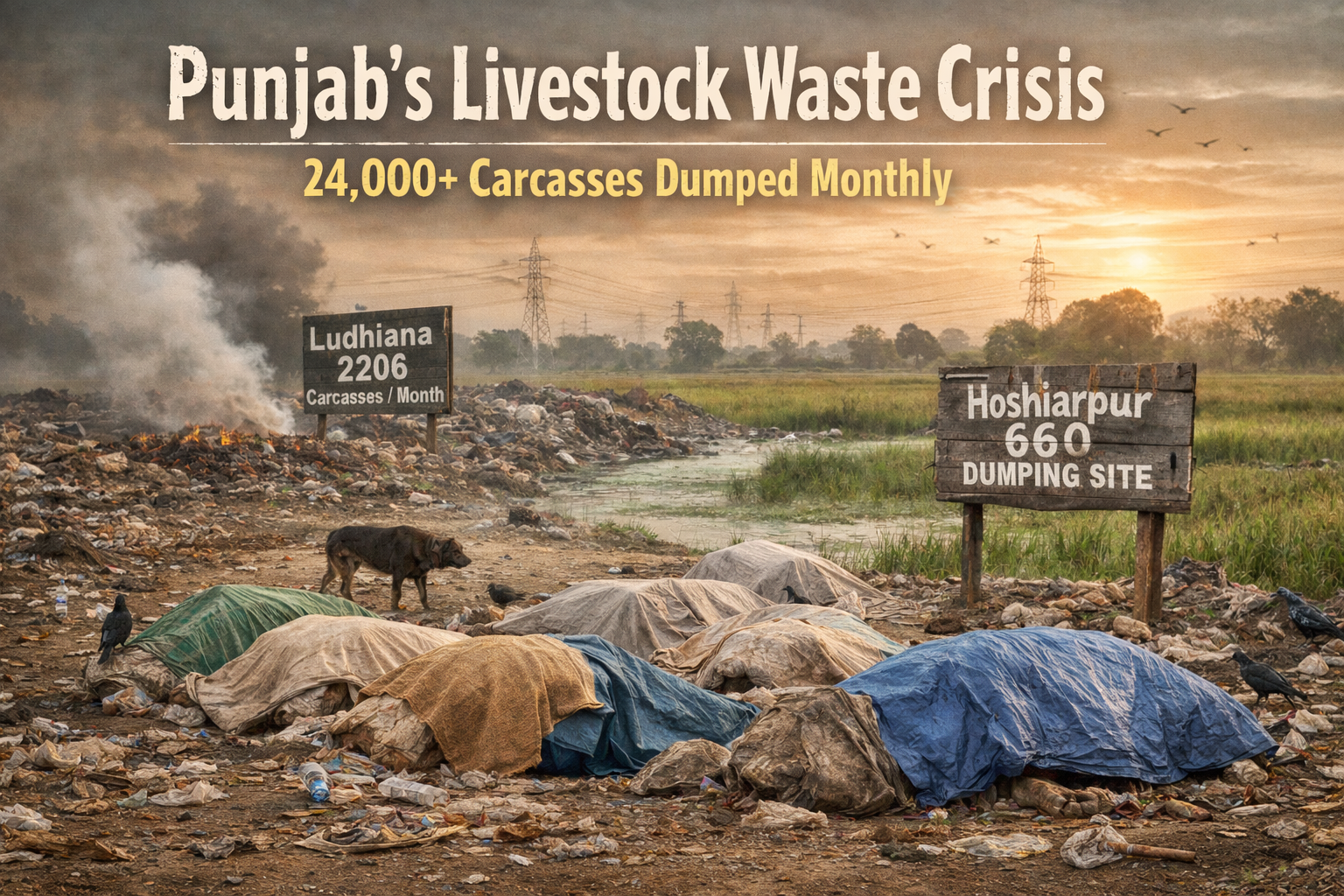
Bathinda, Punjab: A recent audit submitted to the National Green Tribunal (NGT) has unveiled a severe and growing crisis in livestock waste management across Punjab, one of India’s largest dairy and livestock-producing states. The report exposes that more than 24,000 cattle carcasses are being disposed of every month across a staggering 5,541 informal dump sites, mostly unregulated and environmentally hazardous.
This large-scale, unscientific disposal of animal remains has raised alarm among environmental authorities, public health experts, and dairy sector stakeholders alike. The findings were part of an affidavit submitted by Punjab’s Department of Science, Technology and Environment, in response to a long-pending petition seeking action on carcass disposal infrastructure.
Informal Disposal Network Highlights Deep Rural-Urban Divide
The audit reveals that out of the 5,541 identified disposal points, only 24 are within urban municipal boundaries. At the same time, the remaining 5,517 sites are in rural areas and are managed informally by private individuals or local communities. These sites function without regulatory oversight, scientific processing, or waste containment measures.
With Punjab home to approximately 70 lakh livestock, including 65 lakh dairy cattle (cows and buffaloes), the issue directly impacts the Indian dairy industry, particularly in the northern belt where Punjab remains a key milk-producing region.
The absence of proper disposal systems poses critical challenges for sustainable dairy farming, as unattended carcasses increase the risk of disease outbreaks, groundwater contamination, and adverse environmental externalities that affect both animal and human populations.
Ludhiana and Hoshiarpur Among the Worst Affected
According to the data presented, Ludhiana — often regarded as Punjab’s industrial and dairy hub- recorded the highest carcass deaths, at 2,206 per month. Meanwhile, Hoshiarpur leads in terms of disposal site density, with 660 informal dumping grounds. Other central districts with significant dairy activity, such as Bathinda, Ferozepur, and Patiala, are also affected by insufficient carcass disposal mechanisms.
Despite previous NGT orders, the construction of a formal carcass processing facility in Ludhiana has faced persistent delays. The tribunal had earlier directed the Punjab Pollution Control Board and the state’s Department of Animal Husbandry to furnish updates on existing infrastructure, a directive that prompted the current audit.
Environmental and Public Health at Risk
The unregulated disposal of animal remains in open fields, water bodies, or near inhabited areas has profound implications. Decomposing carcasses are known sources of zoonotic diseases, foul odours, and groundwater pollution, particularly dangerous in densely farmed rural districts where communities rely heavily on groundwater for both agriculture and drinking water.
Such practices also breach multiple provisions of India’s Solid Waste Management Rules and Bio-Medical Waste Management Rules, highlighting a significant compliance gap in Punjab’s rural environmental governance.
A Call for Scientific Livestock Waste Management
Experts have called for immediate investments in scientific carcass disposal systems, including biogas-based rendering plants, centralised composting, and thermal hydrolysis units. These technologies not only provide safer alternatives but can also convert biological waste into valuable by-products, such as biofertiliser or energy, aligning with broader goals of eco-friendly dairy practices and sustainable rural development.
Industry observers stress that if Punjab, often hailed as a “milk bowl of India”, fails to implement safe livestock waste management systems, it may compromise both dairy production quality and public trust in dairy safety.