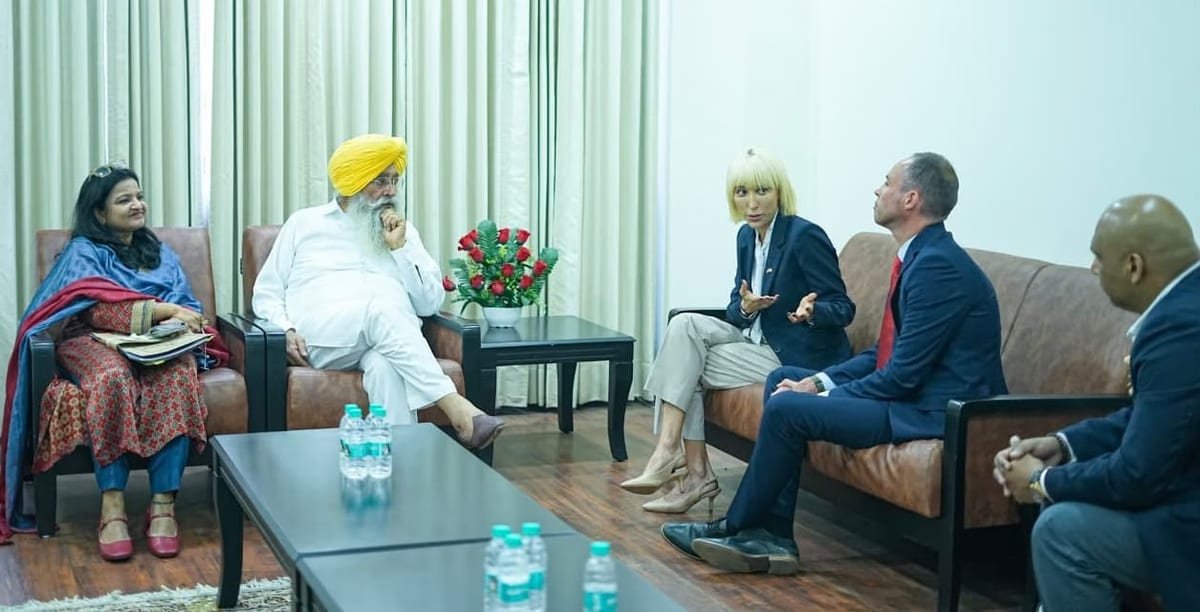
Punjab is seeking greater British investment in dairy technology, food processing and cold-chain infrastructure as the state looks to strengthen its agricultural value chain and expand homegrown dairy brands into international markets. Punjab Agriculture and Farmers Welfare Minister Gurmeet Singh Khudian held discussions with a British delegation in Chandigarh to explore opportunities for bilateral cooperation across dairy, organic farming, crop residue management and quality certification.
The meeting included Principal Secretary (Food Processing) Rakhee Gupta Bhandari, British Deputy High Commissioner Alba Smeriglio, First Secretary Trade Dr Nicholas Gribit and Senior Trade Adviser Anup Narayan. The discussions focused on connecting Punjab’s established agricultural and food-processing capabilities with British technology, investment and market access.
For the dairy industry, the proposed cooperation could create opportunities to modernise processing infrastructure, develop value-added products and strengthen the international presence of brands such as Verka and Five Rivers.
Dairy Technology and International Market Access in Focus
Minister Khudian highlighted Punjab’s strong agricultural foundation and established food-processing ecosystem, positioning the state as a potential destination for international investment. He emphasised that farmer welfare would remain central to any international partnership and assured the delegation of the state government’s support for collaborations.
Punjab’s dairy sector benefits from an extensive milk production base and an established cooperative and processing network. According to the minister, the state leads India in per capita milk availability, at 1.28 litres per day, underlining its importance in the country’s dairy economy.
The state is seeking partnerships that combine domestic production capabilities with international expertise. Technology transfer, modern processing equipment and product innovation were identified as potential areas for collaboration.
Such investments could help dairy processors improve operational efficiency, strengthen product quality and develop products suited to changing consumer preferences. However, the eventual impact will depend on the partnerships established, the technologies adopted and the commercial viability of individual projects.
Verka and Five Rivers Could Gain International Opportunities
A key objective of the discussions is to explore opportunities for taking Punjab’s homegrown brands, including Verka and Five Rivers, into the United Kingdom market.
International expansion could provide these brands with access to new consumer segments and opportunities to diversify beyond domestic sales. However, entering overseas markets typically requires compliance with destination-country food safety requirements, appropriate product certification, reliable logistics and an understanding of local consumer preferences.
Dairy products also present specific challenges because of their storage requirements, shelf-life limitations and sensitivity to temperature variations. Investment in suitable processing, packaging and cold-chain systems would therefore be important in supporting any expansion into international markets.
Potential collaboration with British companies could help Punjab’s dairy businesses evaluate technologies, product formats and distribution approaches suitable for overseas trade. The discussions indicate an interest in exploring these possibilities, although no specific investment commitment or export agreement was announced in the report.
Cold-Chain Infrastructure and Modern Processing
The minister invited British participation in shared infrastructure, including packhouses, pre-cooling facilities and cold-chain connectivity. He also highlighted technology transfer for modern processing equipment and opportunities to develop value-added products from kinnow peels and other agricultural by-products.
Although several of these proposals relate to horticulture, improvements in processing technology, temperature-controlled logistics and quality management are also relevant to dairy operations.
An efficient dairy cold chain helps maintain milk quality from collection through processing, storage and distribution. Modern equipment and improved infrastructure can support product consistency, reduce avoidable losses and help processors manage growing distribution requirements.
For Punjab’s dairy sector, collaboration in these areas could complement existing milk procurement and processing capabilities. Investment in appropriate chilling, storage and transportation infrastructure would be particularly relevant to businesses seeking to expand distribution or explore export-oriented products.
Organic Farming and Quality Certification
The discussions also covered organic farming and quality certification, reflecting a wider effort to improve the competitiveness of Punjab’s agricultural and food-processing sectors.
For dairy businesses, credible quality assurance systems and compliance with applicable food safety standards are important for maintaining consumer confidence and accessing regulated markets. International partnerships could provide opportunities to exchange technical knowledge and improve processing practices.
Any move towards organic dairy products would additionally require suitable production systems, traceability and compliance with the relevant certification requirements. These measures would need to be supported by appropriate sourcing arrangements and clear market demand.
Strengthening Punjab’s Agricultural Value Chain
Punjab’s agricultural strengths extend across milk and dairy products, basmati rice, kinnow, pears, litchi, seed potatoes and other crops. Khudian argued that these capabilities could be connected with British investment, technology and market expertise to create opportunities for farmers and food-processing enterprises.
For the dairy industry, the discussions offer a potential pathway towards improved technology adoption, product development and international brand positioning. The proposed cooperation could also encourage closer links between primary producers, processors and export-oriented businesses.
The meeting represents an effort to explore stronger India–UK agricultural and dairy cooperation. The next step will be translating these discussions into commercially viable projects, with clear investment commitments, technology partnerships and market-access arrangements. If successfully implemented, such initiatives could support Punjab’s dairy modernisation and create new opportunities for its established dairy brands and farming communities.